
European markets end lower
A drop in the oil price, partly due to worries about a demand shortfall if global economic growth slows, EU sanctions on Russia, talk of a possible US Federal Reserve rate hike sooner than the market expects and - in the UK - the continuing uncertainty over the Scottish referendum all combined to send European markets lower, writes Nick Fletcher. The pound slipped below $1.61 as the yes vote continued to put in a strong showing in the polls, while Spanish ten year bond yields rose 12 basis points to 2.192% on talk that any Scottish independence victory could strengthen other separatist movements, not least in Spain’s wealthy Catalonia region. Overall the final scores showed:
- The FTSE 100 finished 5.77 points or 0.08% lower at 6829.00
- Germany’s Dax dipped 0.49% to 9710.70
- France’s Cac closed down 0.5% at 4452.37
- Italy’s FTSE MIB fell 0.68% to 21,149.80
- Spain’s Ibex ended 1.36% down at 10,951.6 (presumably the Catalan effect)
In the US, the Dow Jones Industrial Average is currently down 58 points or 0.34%.
On that note, it’s time to close up for the evening. Thanks for all your comments, and we’ll be back again tomorrow.
Mark Carney declared during his Q&A that the Bank of England pays no attention to politics when setting interest rates.
But Nick Dixon, Investment Director at Aegon UK, isn’t convinced, and reckons there’s little chance of a rate rise this year:
“Mark Carney may have told the TUC today that we should get ready for an interest rate rise, but unless a ‘yes’ vote in Scotland causes a serious shock to Sterling, it’s hard to see this happening before Spring next year. The Bank of England will be wary of attracting perceptions of political bias ahead of the election, and the snail’s pace of wage growth, a key concern for the TUC, presents a thorn in the side of those wanting the base rate to increase.”
Here’s some reaction to Mark Carney’s declaration that a currency union “is incompatible with sovereignty”, from David Nicholls, alliance manager at UKForex:
“The “Yes” camp continues to call Westminster’s bluff by insisting they will be able to keep the pound in the event of independence.
It’s a dangerous game to play, and even Mark Carney appears to be warning against any complacency in this afternoon’s statement. There is no clear answer on currency for an independent Scotland, and if the polls remain tight, we will see an extended period of uncertainty for the pound as a result”
NIESR: UK GDP expanded by 0.6% in June-August quarter
Britain’s recovery has slowed over the summer, according to the latest growth forecast from the National Institute of Economic and Social Research.
NIESR estimated that GDP grew by 0.6% in the three months to August. And it has also lowered its estimate for growth in May-July, to +0.5%.
That suggests that growth in the third quarter of 2014 will not match the 0.8% expansion recorded in the second quarter, unless activity accelerates in September.
NIESR remains at 0.6% ... does suggest there has been a modest slowdown in GDP and that the Q3 is going to be more like a 0.6 than a 0.8%
— Steve Collins (@TradeDesk_Steve) September 9, 2014
On an annual basis, NIESR reckons the UK economy has grown around 2.9% since August 2013.
B&Q: Price rises after independence
Back in Scotland, the boss of B&Q has warned that prices could rise if Scotland votes for independence.
Sir Ian Cheshire, CEO of Kingfisher, told Sky News today that separation would mean increased costs for Scottish businesses, which would then be born by customers north of the border.
Cheshire said:
“We think there is a real risk in terms of higher costs, the uncertainty about a currency union and the difficulty of making investment decisions,” he said on Tuesday.
“Smaller, more complex markets often mean passing higher costs on to consumers.
“Investment decisions would be on pause while we work out what’s likely to happen.
“We are not going to pick up stores and move them south of the border but [a ‘Yes’ vote] would represent real and significant challenge for our business.”
Our Scotland correspondent, Severin Carrell, explains that claims by the no campaign that Scottish consumers would face higher costs in high street stores and the major chains after independence are controversial: Better Together printed a notional Tesco till receipt in its campaign leaflets.
Based on Tesco’s higher prices in Ireland, it claimed prices in Scotland would rise by 16% after independence, because supermarkets would no longer treat its Scottish stores as part of its UK chain and price goods to reflect the real costs of selling them in a smaller market.
A Tesco customer relations manager told one Scottish voter who raised this claim “I can confirm that this is not true”. Tesco would “continue to offer the best prices whatever the outcome of the referendum”. It added that some prices in Ireland were actually lower than in the UK.
Updated
Carney on Scottish currency union. Jan: “requires some ceding of national sovereignty”. Today: “incompatible with sovereignty”
— Ed Conway (@EdConwaySky) September 9, 2014
Scottish referendum raises fears over Catalonia
The Scottish independence battle is having an impact on the rest of Europe, fuelling speculation that other regions could seek sovereignty.
The prospect that Catalonia could renew its push for independence has pushed down the value of Spanish government debt today. This sent the yield on its 10-year bonds jumping to 2.21%, from 2.08% last night.
Poor Spain always gets contagion MT @ReutersJamie: Spanish bond yields jump 15 bps, on fears Scottish indyref momentum could spur Catalonia.
— Lorcan Roche Kelly (@LorcanRK) September 9, 2014
The pound has now slipped back to $1.61, slightly lower than yesterday’s close.
Scotiabank suggests that sterling’s immediate slump could now be over, at least until the referendum has been held on September 18.
Analysts at Scotia write that the uncertainty and risk is now priced into GBP, leaving GBP likely range bound until the vote on Sept. 18th
— RANsquawk (@RANsquawk) September 9, 2014
Updated
Mark Carney’s Liverpool speech appears to have been well-received, especially his comments about how British pay packets have born the brunt of the economic pain since the financial crisis began.
TUC General Secretary Frances O’Grady has just issued this statement:
“Mark Carney recognised the pain felt by British workers from pay cuts deeper than any since the 1920s, and he was clear that Britain deserves a pay rise.
“His strong support for the living wage, not least by making the Bank of England an accredited living wage employer, should be heard across government and the public sector.
“And his caution on interest rates may have been carefully phrased, but showed he understood the worries of households hit by the living standards squeeze.”
Mark Carney has pretty much ruled out an interest rate rise this year, given his comments on pay, reckons Howard Archer of IHS Global Insight.
He says:
It is notable that the Governor commented that “we will be closely monitoring pay settlements that are bunched around the turn of the year and taking a steer from the pay of new hires as a potential leading indicator of pay pressures”.
This suggests that most Monetary Policy Committee members want to see concrete evidence that pay is starting to pick up before raising interest rates.
Apparently Carney said currency union is incompatible with *sovereignty*, not "Scotland". Essentially a restatement of what he said in Jan
— Ed Conway (@EdConwaySky) September 9, 2014
Carney on Independent Scotland: currency union is incompatible with sovereignty
Mark Carney, governor of the Bank of England, has just told the Trades Union Congress in Liverpool that an independent Scotland could not have a currency union with the rest of the UK and also enjoy full sovereignty.
He was asked by a delegate whether an Scotland could keep the pound in a currency union if it votes for independence next week.
Carney replied by reminding the TUC of the speech he gave in Edinburgh in January, in which he outlined the Bank’s position on this issue.
There are three components of a successful currency union, he says:
First, you have to have free movement of capital and labour and goods and services, trade, across the various parts of the currency union.
Secondly, you need a banking union. You need the same regulation, the same supervision, the same standards in the banking sector, and very importantly you need the same institutions that stand behind those banks. The lender of last resort, which is a central bank, and a deposit guarantee scheme that is credible. You need all those institutions.
And thirdly, you need some form of fiscal arrangement. You need tax, revenues and spending flowing across those borders to help equalise, to an extent, some of the inevitable differences [across the Union].
We only need to look across the Channel to see what happens if you don’t have all of those components in place, the governor says.
That’s just the economics of it.
Carney then concludes:
We take note of the positions of all the major Westminster parties to rule out a currency union between an independent Scotland and the rest of the UK.
In that context, a currency union is incompatible with sovereignty.
<polite applause from the TUC>
Carney restates position on Scotland. Given resistance of Westminster parties "a currency union is incompatible with independent Scotland".
— Joel Hills (@ITVJoel) September 9, 2014
Mark Carney: in context of currency union refusal "a currency union is incompatible with sovereignty"
— Faisal Islam (@faisalislam) September 9, 2014
On skills, Mark Carney says “there is nothing worse than wasting human capital.... wasting a life, wasting skills.”
Updated
What impact is the boom of zero hours contracts having?
Carney says the Bank looks past the topline unemployment rate, to issues such as part-time work, self-employment, to show how much slack remains.
Updated
Carney: Bank needs to understand impact of pay inequality
A question on tax evasion, and whether the tax system should be more redistributive?
Mark Carney declines to comment directly on fiscal policy - he can’t give views on taxation.
But he does signal that pay inequality is a major issue for the Bank of England.
The shift of wage growth - faster at the top end, and tepid (or worse) at the low end, affects monetary policy and we need to understand that, says Carney.
It comes back to “who has the debts in the economy, who has the ability to service those debts”, and what does that mean to the recovery.
And he pledges that the BoE will do what it can do to ensure durable wage growth for all.
What can the Bank do about the ‘unsustainable growth’ in house prices?
Carney says that the Bank’s macro-prudential tools allow it to control the market without having to raise interest rates.
But the BoE cannot solve the supply problems. We can’t build more houses.
*CARNEY: BOE WILL RAISE RATE BEFORE ELECTION IF NECESSARY
— Michael Hewson (@mhewson_CMC) September 9, 2014
What impact does politics have on monetary policy, and when the Bank will raise interest rates?
We are absolutely indifferent to the political cycle, Mark Carney replies.
We have a specific mandate. Basically unchanged since 1997, to achieve that 2% inflation target.
If we need to raise rate, or lower them, before the May 2015 election to achieve the target, we will do what’s necessary. We are technocrats, he insists.
Updated
What is the Bank of England doing to encourage banks to support to the real economy?
Carney replies that it is much more expensive for the banks to engage in City trading rather than to lend to the real economy.
These are “lumbering institutions”, it takes them a long time to adjust, but they need to lend more to the real economy, to the creative industries, he adds.
The questions from the TUC delegates are being bundled together.
On household indebtedness....
Carney says he welcomed the focus on this issue. We see through surveys that 40% of households feel “acutely” the impact of their indebtedness. It’s one of the factors that influences monetary policy.
What is important, he explains, is that there is a promise of wage increases to reduce that indebtedness. As the extra workforce finds employment, as the slack is used up, we start to see those prospects.
Carney: Weak public sector wage growth is a crucial issue
The first questions to Mark Carney focus on the public sector pay freeze - what impact will weak wage rises in the public sector have on economic stability?
The Bank of England governor says it is a very important issue.
It is one of the reasons why we are very conscious about the pace and degree of potential interest rate increases, he tells the TUC.
This is something that we are taking very seriously. It is one of the reasons we acted on housing earlier this year.
In an environment of low wage growth, strong house price inflation could store up problems in the future, Carney adds. Thus the new affordability measures brought in by the Bank.
Mark Carney taking questions at the TUC now
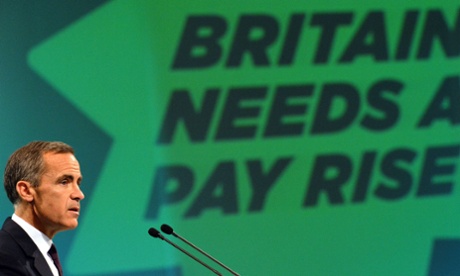
Mark Carney finished his speech, as flagged up earlier, by declaring that UK firms and workers must deliver skills and productivity improvements “so that the British people get the pay rise they deserve.”
Now onto questions....
Another angle on Scottish independence, from Citi.
Citi on the #indyref: "An unstable Scottish currency would make it difficult to price Scotch."
— Juliet Samuel (@CitySamuel) September 9, 2014
Carney says the Bank of England will be watching pay deals closely, to see if the recovery is feeding through to workers’ pockets.
And on interest rates, Carney says that borrowing costs will not return to their pre-crisis levels, even once the Bank of England starts to hike.
Mark Carney is now explaining to the TUC that the Bank was right not to raise interest rates already, even when inflation was over target.
We understood that there was plenty of spare capacity in the labour market, and that the recovery was fragile. Our forward guidance (his forward guidance, really) encouraged firms to invest and hire, Carney declares.
Now, the recovery has exceeded expectations, and our job is to ensure it is durable and lasting, he says.
Reminder, the speech is here.
Mark Carney Forward Guidance "The expansion of labour supply does not mean permanently weak growth of real incomes." #BoE
— Shaun Richards (@notayesmansecon) September 9, 2014
Mark Carney’s promise to make the Bank of England a living wage-payer within the year went down well with the TUC....
Round of applause for Carney as he vows to make Bank of England living wage employer #TUC2014
— Owen Bennett (@owenjbennett) September 9, 2014
Mark Carney addresses TUC. Their message is simple, clear and inescapable. pic.twitter.com/ZPGsP9bNMx
— Joel Hills (@ITVJoel) September 9, 2014
Carney: Britain's workers need productivity boost to earn pay rise
Mark Carney’s speech to the TUC runs to 12 pages, plus charts. And Congress is running late, so it’s not started yet.
But his key point is that Britain’s workers need a pay rise, but they’ll need to deliver improved productivity to deserve it:
Here’s his conclusion:
We are under no illusions. The Great Recession was a calamity. Britain’s workers have borne many of the consequences.
Our job is to ensure the economy achieves its potential and to maintain price and financial stability, for sustainable growth in jobs and incomes.
But monetary policy cannot do it alone.
Others – including trade unions, government and businesses – will determine the potential of this economy. You will ultimately determine the size of Britain’s pay rise.
Those in work need to be able to seize new job opportunities in a world where technology and globalisation cause labour markets to shift rapidly.
Skill levels need to be raised continually. That is of course first and foremost about education. But crucially it also means access to lifelong learning, both on and off the job, available to all.
The TUC’s engagement with the UK’s skills agenda is a major contribution to realising that imperative. In the past year alone, unionlearn, has supported over 200,000 people to invest in their skills.
Such investments are crucial for the durability of this economic expansion and for Britain’s future. They will help to deliver long-term productivity – so that the British people get the pay rise they deserve.
Full Carney speech here. http://t.co/SUuvfZK1dD Things running late here so he isn’t due to deliver it for another 10 minutes
— Ed Conway (@EdConwaySky) September 9, 2014
And here are some charts:
Carney: real wages could rise in mid-2015
Mark Carney also indicates that UK wages will finally rise above inflation in the middle of next year.
In early 2014, there were hopes that real wages could turn positive this year, but recent weak earnings figures have dashed those hopes.
*CARNEY: BOE EXPECTS REAL WAGE GROWTH TO RESUME AROUND MID-2015
— World First (@World_First) September 9, 2014
Carney digested: 1. Real wage squeeze to end mid-2015, 2. Market expectations for rate rise next spring look right, 3. Jobs outlook is good
— Ed Conway (@EdConwaySky) September 9, 2014
Carney: UK rates could rise next spring to meet Bank mandate
Mark Carney has also given the TUC a clear signal that UK interest rates could start to rise next spring, to meet the Bank of England’s mandate of ensuring price stability.
He says that TUC members “can expect interest rates to begin to increase”, even though there are few signs of inflationary pressures now.
With inflation at 1.6%, continuing downward pressure from the appreciation of sterling, and with slack remaining, the current inflation environment is benign.
But it will not remain benign if we do not increase interest rates prudently as the expansion progresses. Our latest forecasts show that, if interest rates were to follow the path expected by markets – that is, beginning to increase by the spring and thereafter rising very gradually – inflation would settle at around 2% by the end of the forecast and a further 1.2 million jobs would have been created.
In other words, we would achieve our mandate.
That has given the pound a little lift, to $1.613 against the US dollar.
Breaking: BOE will likely meet inflation, jobs goals if it raises benchmark interest rate early 2015, Carney says http://t.co/tYCeELTJqc
— Wall Street Journal (@WSJ) September 9, 2014
Mark Carney at the TUC
Over in Liverpool, Bank of England governor Mark Carney is due to begin speaking at the Trades Union Congress.
His speech has just been released, and the first piece of news is that the Bank of England aims to become an accredited Living Wage employer within the year. That means all staff will receive at least £7.65 per hour, or £8.80 per hour in London.
Carney says a living wage is an issue of “human dignity”:
The growth and distribution of jobs and incomes matter to everyone.
Employment does much more than provide the means to support workers and their families; it is essential to personal fulfilment and human dignity.
Part of that dignity is being paid a living wage.
Over the past year, the Bank of England has ensured that its pays all of its 3,600 staff at least the living wage.
And we have recently brought all our contracted service staff in central London up to the London living wage.
We are in the process of our final review. But I can announce today the Bank’s intention to become an accredited Living Wage employer by the time of the next TUC conference.
More to follow...
Heads-up. Just under 15 minutes until Mark Carney, governor of the Bank of England, begins speaking at the TUC conference in Liverpool.....
In Liverpool where Mark Carney’s talking at TUC conference. Big question is whether the @bankofengland Governor intervenes on Scotland again
— Ed Conway (@EdConwaySky) September 9, 2014
Updated
Chart of the day: still nil improvement in UK's balance of trade in goods, which which is running at £10bn a month pic.twitter.com/0uEdSIeBVx
— jeremy warner (@JeremyWarnerUK) September 9, 2014
Data firm Markit reckons that Scotland’s economy has lagged the UK average over the last year.
It poll companies across the globe each month to assess the latest activity, output, employment and export figures.
#Scotland has seen weaker economic recovery than the UK as a whole over the past year. PMI surveys compared ... pic.twitter.com/WVJUVkBaYz
— Chris Williamson (@WilliamsonChris) September 9, 2014
https://twitter.com/WilliamsonChris/status/509281525612150784
#Scotland in fact saw weakest PMI reading of all UK regions in August http://t.co/qaU1FguD3A pic.twitter.com/rnJ6RhMu8v
— Chris Williamson (@WilliamsonChris) September 9, 2014
Thales CEO: Scottish yes vote could hit investment
The head of Thales Group, one of Britain’s largest defence suppliers, has warned that jobs and investment on both side of the border could be hit if Scotland votes to leave the United Kingdom.
Jean-Bernard Levy, CEO of France’s Thales, has told Reuters a ‘yes’ vote could fuel uncertainty.
Speaking at a defence conference in southwest France, Levy said a yes vote would “inevitably” mean an investment freeze. An “amputated Britain” without Scotland would raise questions, he added.
Levy told Reuters that:
“It is very difficult to make any sort of predictions, (but) it is clear that if it is cut off from Scotland, the rest of Great Britain will have fewer resources to devote to defence and this will inevitably lead us to re-examine our industrial framework,”
”There would be questions over the capabilities we keep in the UK and there would also be questions over the facilities we maintain in Scotland,”
Thales is Britain’s second-largest defence contractor, with 7,500 employees. That includes around 500 at Govan, Glasgow, where it makes submarine periscopes for the Royal Navy.
Updated
FCA: Contingency plans underway for Yes victory
Back to the Scottish independence vote.
And over in Parliament, the head of the Financial Conduct Authority has told the Treasury Committee that “contingency plans” are underway in case the pro-independence side win on September 18.
FCA tells Andrew Tyrie basic contingency planning in place for Scottish yes vote: eg phone lines to handle calls from consumers
— Jill Treanor (@jilltreanor) September 9, 2014
FCA chair John Griffith-Jones tells Treasury select committee there will be a "lot of work to do" in the event of yes vote by Scots
— Jill Treanor (@jilltreanor) September 9, 2014
The better-than-expected UK industrial production data (see 9.35am) has pushed the pound back over the $1.61 mark, having hit a 10-month low this morning.
This morning’s data shows Britain has a long way to go to return its industrial sector to its pre-crisis state, says business retail bank Aldermore:
@graemewearden Definitely puts recent growth in perspective. Still a long way to go before we can really talk of a rebalanced economy.
— Aldermore Bank (@AldermoreBank) September 9, 2014
And here’s more details of how Britain’s imports and exports with major trade partners changed in July:
This chart shows how the deficit in Britain’s trade in goods with the European Union, and with the rest of the world, both deteriorated in July:
UK trade deficit widens to £3.3bn
Disappointing news on UK trade, again.
Britain’s deficit of goods with the rest of the world has widened unexpectedly in July, to £10.2bn. That’s up from £9.4bn in June, worse than expected.
And although Britain recorded a £6.8bn surpluses on services, that wasn’t enough to prevent the trade deficit widening to £3.3bn in July 2014, from £2.5bn in June.
Imports rose by £1.3bn, outpacing the £500m increase in exports, dashing hopes that Britain’s economy might be rebalancing.
The ONS reports that trade in goods with non-EU countries accounted for the majority of the increase in exports and imports in July 2014, suggesting that demand from the eurozone was weak.
So we have seen this morning yet another set of poor trade figures from the UK in what is a long running series #GBP
— Shaun Richards (@notayesmansecon) September 9, 2014
So we have seen this morning yet another set of poor trade figures from the UK in what is a long running series #GBP
— Shaun Richards (@notayesmansecon) September 9, 2014
Details and reaction to follow...
The ONS confirms that industrial production is still 11.3% below its pre-crisis peak, in the first quarter of 2008. The manufacturing sector is 7.6% smaller.
UK production, the details
UK industrial production is up by 1.7% over the last year, the ONS reports.
That annual increase was driven by:
rubber, plastic products & other non-metallic mineral products; the manufacture of transport equipment; and the manufacture of basic metals & metal products.
The 0.5% monthly increase in production in July was mainly due to increased energy production (electricity, gas, steam & air conditioning).
But as this chart shows, the sector is still below its pre-crisis peak:
UK industrial production beats forecasts
Just in : UK industrial production has posted its biggest rise since February.
Industrial production rose by 0.5% month-on-month in July, a stronger reading than the 0.2% which economists had expected.
The manufacturing sector also grew its output by 0.3%, the Office for National Statistics reported, broadly as forecast.
UK Industrial Production 0.5% MoM vs 0.2 exp. Manufacturing Production 0.3% MoM vs 0.3% exp. #GBP AB
— IGSquawk (@IGSquawk) September 9, 2014
Updated
The referendum race is now clearly too close to call - http://t.co/vyILpX84Bj - via @spbaines
— World First (@World_First) September 9, 2014
Sterling volatility hits near three-year high
City investors are dashing to insure themselves against losses from the pound’s volatility over the next month.
The cost of hedging against further sterling weakness just hit its highest since late 2011 on Tuesday, following the latest polls showing the independence race is too close to call.
- STERLING/DOLLAR ONE-MONTH IMPLIED VOLATILITY HITS 10.105 PERCENT, HIGHEST SINCE NOV 2011, ON SCOTLAND WORRIES
Updated
World Bank, ILO and OECD sound alarm over global jobs market
There is another gloomy assessment of the world’s jobs market this morning.
The International Labour Organisation, the World Bank and the Organisation for Economic Co-operation and Development (OECD) have produced a labour market update for the G20 employment and labour ministers’ meeting in Melbourne, my colleague Katie Allen reports.
It highlights that “large employment gaps remain in most G20 countries”, referring to grouping of the world’s biggest developed and emerging market economies.
The authors also worry that “the quality of employment remains a concern” and that “the deep global financial and economic crisis and slow recovery in many G20 countries has resulted not only in higher unemployment but also in slow and fragile wage gains for G20 workers.”
The paper concludes:
“Seven years after the onset of the global financial and economic crisis, the economic recovery may be strengthening but remains weak and fragile. The employment challenges across most G20 countries are still very sizeable both in terms of a persistently large jobs gap and low quality of many available jobs.
The current growth trajectory, if unchanged, will not create enough quality jobs – giving rise to the risk that the jobs gap will remain substantial, underemployment and informal employment will rise, and sluggish growth in wages and incomes will continue to place downward pressure on consumption, living standards and global aggregate demand. Underlining these challenges is the fact that income inequality continues to widen across the G20 countries.
“The G20 commitment to boost GDP by more than 2% by 2018 over and above the baseline projections is certainly a welcome step, although it will be important to ensure that this additional growth is job-rich and inclusive.”
Full story here: G20 handed gloomy jobs market report
Euro hits 14-month low against the dollar
Elsewhere in the currency markets, the euro has fallen to its lowest level against the US dollar since July 2013, at trading at $1.2860.
The euro has been weakening since last Thursday, when the European Central Bank cut interest rates and announced a new asset-purchase scheme to fight deflation.
Euro hits 14 month low of $1.2860 against dollar #Draghi #ECB
— Chris Adams (@chrisadamsmkts) September 9, 2014
Analysts at BNP Paribas also reckon that the pound will be buffeted by the twists and turns in the referendum battle in coming days:
“We expect political concerns surrounding the September 18 Scottish independence referendum to dominate price action.”
(via the WSJ).
The pound’s weakness is partly due to the strength of the US dollar, which hit a six-year high against the Japanese yen overnight.
But while today’s drop in sterling is pretty mild, it continues a trend that began in mid-July. Since then, the pound has shed 10 cents against the US dollar, a significant move.
Part dollar move, part Scottish vote jitters - sterling has fallen sharply in the last two months: pic.twitter.com/IQRg28EaDa
— Jamie McGeever (@ReutersJamie) September 9, 2014
The UK Pound £ remains under pressure this morning as it trades at US $1.608 #GBP
— Shaun Richards (@notayesmansecon) September 9, 2014
London market open
Away from the frenzy in Scotland, the London stock market has opened calmly, although events north of the border continue to dominate attention.
Scottish bank shares are recovering from yesterday’s selloff. Lloyds Banking Group are up 1.8%, and RBS has gained 0.9%.
But SSE (formerly Scottish and Southern Energy), has shed another 0.5% in early trading.
James Knightley of ING says a yes vote would create:
...economic and political uncertainty that will potentially be damaging for both growth and asset prices.
But right now, the FTSE 100 is up just 7 points, or 0.1%. Here’s the top risers:
Graph: how the gap narrowed.
This chart showing how the Yes campaign has chased down Alistair Darling’s ‘No’ campaign in recent weeks (with thank to Berenberg bank).
Despite the latest polls, many City economists reckon that the No campaign will stagger over the line in first place on September 18.
Parallels are drawn with Quebec, which narrowly voted against splitting from Canada in 1995 after a nail-biter of a race.
Rob Wood of Berenberg says:
Voters may find it harder to support change in the polling booth than when talking to a pollster.
Notwithstanding these arguments, the pace of poll tightening is raising the risk that Scotland does plump for independence. Recent polling evidence suggests, in fact, that the more Scottish voters hear about the independence debate, the more likely they are to vote for it.
I suspect they’ll be hearing about little else for the next couple of weeks, at least...
Updated
The prospect of Scotland going it alone has spooked investors at a time when they were already worried about the weak European economy.
Jonathan Sudaria, dealer at Capital Spreads, says:
The economic outlook from the continent still remains weak and the potential fallout from the Scottish Independence vote still drapes uncertainty over the UK.”
IG: Pound could fall below $1.60
Westminster’s pledge to devolve more powers in a “modern form of Scottish home rule” is unlikely to prevent the pound falling further, reckons Stan Shamu of IG.
He predict more volatility in the run-up to the independence referendum on 18 September:
Until a concrete plan emerges and we get more clarity of a shift in momentum in the polls, cable is likely to remain under pressure. Until then, there is a good chance we’ll see cable extend its losses and could even test $1.6000 in the near term.
Updated
Neck. And. Neck. Latest #indyref poll shows Scottish independence vote too close to call: pic.twitter.com/5UxOMq8lRC
— Jamie McGeever (@ReutersJamie) September 9, 2014
Pound falls to $1.6066 after latest Scottish poll
The pound has fallen to a fresh 10-month low overnight as the prospect of Scotland voting for independence next week sends reverberations around the financial markets.
Sterling fell as low as $1.6066 in early trading today, down from the $1.6137 set at 5pm yesterday at the end of a dramatic day’s trading.
The selloff was fuelled by a new opinion poll, released at midnight, which found that the two sides in the Scottish referendum are neck-and-neck.
TNS reported that the no side’s support has slipped to 39%, down from 45% last month.Yes’s support has surged to 38%. from 32%. And among those certain to vote, “No” and “Yes” are tied on 41% each.
The poll puts new pressure on companies and investors to draw up contingency plans in the event of a “Yes” vote next week.
As Michael Hewson of CMC Markets puts it this morning:
Any increase in political or economic uncertainty is always likely to make investors nervous, and a Scottish “Yes” vote would create this in spades, which suggests we will continue to see further market weakness, due to the numerous unknowns, if the polls continue to move in the “Yes” camps favour.
The TNS poll was taken before Gordon Brown weighed into the battle with a promise to offer new powers to Scotland if it rejects independence. That pledge, though, hasn’t yet given the pound any relief.
Tuesday's Guardian - "Brown to the rescue? No camp sends for ex-PM to save union" #tomorrowspaperstoday #indyref pic.twitter.com/aNXSb35H1O
— Nick Sutton (@suttonnick) September 8, 2014
Reaction to follow...
The agenda
Good morning, and welcome to our rolling coverage of the financial markets, the world economy, business and the eurozone.
The Scottish referendum looms over the markets today, after the pound and shares in Scottish companies tumbled yesterday.
Sterling’s weakness has raised the prospect that UK interest rates could stay at record lows for longer. Something for Bank of England governor Mark Carney to ponder on his way to Liverpool.
Carney is speaking at the TUC’s annual conference, from 11.45am BST today.
On the economic front, we get the latest UK trade and industrial/manufacturing data, at 9.30am. That could also give the pound a jolt.
And at 3pm, the NIESR thinktank will publish its estimate for UK growth in the three months to August.
Looking ahead, attention now turns towards UK ind&manf production, with ECB’s Liikanen and BoE Governor Carney both due on the speaker slate
— RANsquawk (@RANsquawk) September 9, 2014
European stock markets are expected to lose ground this morning, as the prospect of fresh sanctions against Russia weigh on shares. EU governments agreed new measures overnight, but it’s not clear when they will be implemented.
Share markets seen opening lower with little to inspire investors to buy. Financial bookies: FTSE100 -14, DAX -33, CAC40 -15
— Peter Hoskins (@PeterHoskinsSky) September 9, 2014
I’ll be tracking the main developments through the day.
