
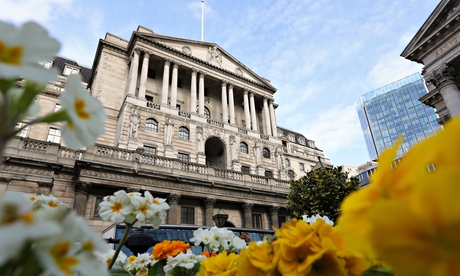
There is no upward pressure on wages. The rate of unemployment has fallen sharply but new jobs are being created more slowly than at the start of this year. The economy may be slowing a touch. Inflation, ignoring the price of houses, stands at just 1.5%. Crude oil has slipped below $100 a barrel. The eurozone, our biggest export partner, may be descending into another economic funk. Why is there even a debate about increasing interest rates now?
One argument advanced by the two dissenters on the Bank of England's monetary policy committee – Ian McCafferty and Martin Weale – is that a modest hike now would help to ensure rises are "gradual", which is the Bank's big hope.
That position is perfectly respectable. The Bank will look foolish if it has over-dosed on ultra-low interest rates and is forced to react in a hurry next year if the elusive wage-growth appears.
It's just that it's hard to imagine the dissenters winning converts this side of Christmas. The bigger worry, one suspects, is that "a premature tightening in monetary policy might leave the economy vulnerable to shocks," as Wednesday's minutes described one of the majority's arguments.
Put yourself in Governor Mark Carney's shoes. It is conceivable – just - that inflation on the CPI measure could fall below 1% in coming months, prompting an explanatory letter to the chancellor. Would you simultaneously want to be explaining why you've just raised the cost of borrowing?
An increase in February, at the earliest, still seems the way to bet.
Activist investor
Edward Bramson, the bashful bruiser laying siege to Electra Private Equity, has finally spoken. What's more, the activist investor has announced a big number. Bramson reckons "more than" £1bn of value can be scooped up if only he and a sidekick can get themselves into Electra's boardroom to tell the incumbents what they have been doing wrong.
In other words, Electra's share price, currently £27.20, can become £60. That boast will certainly grab shareholders' attention. It's also a better approach than merely saying you own 20% of Electra and thus would like a couple of boardroom seats, which was the position of Sherborne, Bramson's investment vehicle, until now.
But there's a problem. Bramson doesn't say how the £1bn miracle would be performed. Instead his dispatch to Electra's shareholders was a dense analysis of the fund's shortcomings.
Parts, to be fair, carried a thump. Look, argues Bramson, at how Electra raised expensive debt in 2009 and 2010 but sat on the cash and wasted opportunities to buy at the bottom, all the while paying fees to Electra Partners, the fund's investment manager, to "manage" that cash by parking it in a bank. He reckons £22.7m has drained away that way. Good point – and it is always useful to remind private equity partners of their feather-bedded fee arrangements.
But cutting £22.7m of cheeky fees doesn't get you to £1bn. What's the plan? Bramson devotes chunks of his letter to his own cost-cutting credentials, so one assumes he wants to wield an axe at the companies in which Electra invests. But this is just a vague short-term aspiration, not a thought-out strategy.
Bramson has a loyal City fan club, so it's possible he'll get himself voted onto the board on 6 October. But, on the evidence of this letter, his services are not required. Come on, if you think there's £1bn up for grabs, say where it is – or, if you're really confident, round up some financial backers and make a full bid.
Financial protection
After the run on Northern Rock in 2007, you would have assumed the authorities had learned to make their statements about deposit guarantees 100% clear at the first time of asking. Not exactly. The Financial Services Compensation Scheme has required two attempts to get its wording correct about the Scottish referendum.
The FSCS, remember, guarantees deposits of up to £85,000 in UK authorised banks, building societies and credit unions. What, the punters wanted to know, would happen if Scotland votes to leave the UK?
The FSCS's first effort last week was horribly vague. It said there is "likely" to be a transitional period and "during any such period, we expect consumers will continue to be protected by the FSCS".
Likely? Expect? For those inclined to worry,it was less than reassuring.
Thankfully, a proper statement has now been issued. If the vote is yes, all depositors "including those based in Scotland" will continue to receive full protection. Further: "The current arrangements would continue throughout the transition period until the date of formal separation." That – finally – leaves no room for doubt.
