
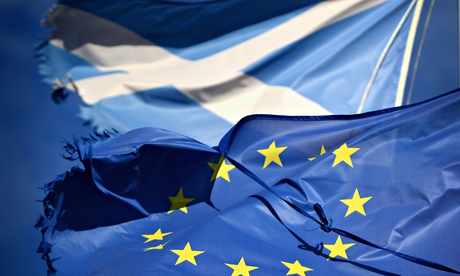
On a run-down industrial estate outside Glasgow, bulletproof vest maker Sam Sarkar is counting the cost of the referendum outcome.
He was among the 45% of Scots who voted yes, because he wanted more self-determination for his country. And despite the flood of dire warnings about the economic effects of a yes, as a businessman Sarkar thought leaving the UK would bring more security to Scotland than remaining part of it. Independence for Scotland was, in his mind, the safest way to stay in the European Union.
Sure, it would take time, but there was clear political ambition and popular support in Scotland for being part of the EU. For the barely United Kingdom meanwhile, the chances of an in/out popular vote on membership are growing.
In Westminster the view is that keeping Scotland and its millions of largely pro-European voters has diminished the chances of a so-called "Brexit" if it comes to a popular vote.
But Sarkar did not want to take that risk. In a time of global instability, demand for bulletproof vests and helmets is soaring and his products are shipped to 40 countries. More than 95% of Sarkar Defence's £3m estimated sales this year will come from exports. The company buys in raw materials from around Europe. Sarkar puts it simply: "For my business it is absolutely critical to be in Europe. I do not want an in/out referendum on that."
The manufacturer's fears about a potential breakaway from the world's largest single market are widely shared. The pro-independence alliance of companies, Business for Scotland, warned that "threats from David Cameron's government are taking the UK, and by extension Scotland, closer to the exit door of the EU".
More widely, when the Scottish Chambers of Commerce polled its members in May, it found 61% of businesses believed that remaining in the UK but leaving the EU would damage their business.
Their fears over an EU exit will only have intensified in recent days. Cameron has already pledged a referendum on Britain's EU membership by the end of 2017. Last week, Ed Miliband came under fresh pressure from trade unions to make the same promise. The Labour leader's resistance was not helped by the finding that a majority of Labour supporters are in favour of an in/out vote, according to a survey from the thinktank British Future.
It is further ammunition for Britain's largest union, Unite, which says failing to offer a referendum would leave Labour weighed down by an "electoral millstone" next May.
As Ukip strives to centre the political debate on immigration, there will be more calls on Labour to promise a referendum. There is a very good chance that whoever wins the general election, Britain will be once again facing the possibility of a huge shakeup. Barely recovered from Scotland's vote, drained from fighting a tight general election, whatever government is cobbled together next May risks spending its first two years distracted by another referendum.
We can only hope this broader referendum wins the same popular engagement as the Scottish vote. But we should also brace ourselves for the two contradictory narratives this time to be riddled with an even more liberal use of statistics and wilder extrapolation. If you thought Salmond and Cameron were miles apart when they conjured up projections for the North Sea's oil reserves, wait till you hear the lines about jobs to be lost or gained from sticking with the EU.
Businesses believe even more is at stake this time. When Deloitte consultants polled chief financial officers in some of the biggest companies this summer, they ranked the prospect of an EU referendum as a bigger risk than Scotland's independence vote.
So they should. As was the case with Scotland, decisions will be delayed as a poll draws nearer. Regardless of the outcome, the mere fact a referendum is taking place will probably cost lucrative trade contracts and investment. Some will merely be delayed, but some will be lost permanently. With plenty of other attractive markets around the world, our trading partners could quite well choose not to hang around for the verdict on EU membership. They will simply take their business elsewhere.
In short, when and if an EU referendum is scheduled, expect political and economic upheaval.
But the parallels with Scotland's vote only go so far. Here is what not to expect this time: 11th-hour promises and rousing speeches from the rest of the (European) union. Better Together had Gordon Brown's impassioned rhetoric; it parachuted in Westminster bigwigs to make hurried vows for new Scottish powers. Let's not kid ourselves that Angela Merkel and François Hollande will be jetting over with last-minute concessions to sway British voters. It's simply not practicable in a 28-member union. Even if it was, giving in to brinkmanship would merely invite copycat tactics around Europe, destabilising the entire union.
And anyway, why should the rest of the EU come begging? Who's to say that, by that stage, our neighbours will still believe they are better together with the UK?
There is a very real prospect of an EU referendum. And there is a very real threat it will end with the UK sitting outside on the doorstep of a huge trading power. Manufacturers like Sarkar are right to be worried.
