
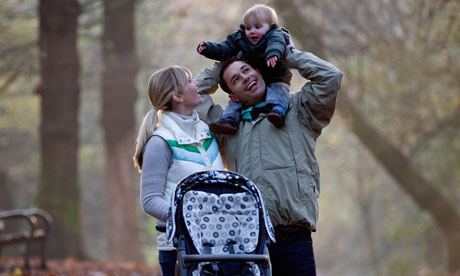
Back in the autumn of 2010, just before the Conservative conference, the press was being briefed in advance about one announcement which, it was suggested, would demonstrate that the Tories had changed. Everyone knew cuts were coming, of course, but George Osborne's speech laid heavy stress on one cut in particular – the withdrawal of child benefit from higher-rate taxpayers. It was duly reported that this move, controversial with some of the traditional Conservatives it would hit, provided real evidence that the chancellor was serious in talking about progressive austerity, and demonstrating that "we are all in it together".
Even at the time this seemed a bit dubious, coming as it did a few months after a budget that had ratcheted down benefits for the poorest, by decoupling them from the overall rise in the cost of living. Within a few weeks the rhetoric was confirmed as cant, when the chancellor published a spending review that took twice as much extra money from the sick and the poor – through, for example, time-limiting benefits, scrapping nationwide council tax relief, and forcing poor renters to share homes right into their mid-30s – as from well-to-do families. Taking the budget and spending review together, the snatching back of the rich's child benefit was going to contribute less than 15% of the annual £18bn being chopped from the benefits bill, the remaining 85%-plus was to come from other cuts that overwhelmingly fell on those at the bottom of the heap.
So, the child benefit cut was always something of a fig leaf. Extraordinarily, however, the government has now chosen this week – the very week in which its assault on disability benefits has been thrice defeated in the Lords – to signal that it is considering starting to peel its own fig leaf away. David Cameron, Jeremy Hunt and Michael Gove have all been out on the airwaves saying that there are real issues with the brutal way in which the child benefit clawback will work for higher-rate taxpayers, and that the policy needs to be "re-examined", with a little soothing (and presumably costly) balm somehow applied.
Now I'm no great fan of the child benefit policy, I've written before that if you want to take such payments back from the better off it is better to tax them than axe them. It is also true that there are inconsistencies, in the sense that a £70,000-a-year couple earning £35,000 a piece will escape punishment, whereas a family where the £50,000-a-year father is the only one bringing home the bacon will be hit hard. But this was evident from when policy was conceived. Since 1990, people have been taxed as individuals rather than couples, and officials would have explained to ministers perfectly clearly that, unless you wanted to undo this feminist advance, then the logical consequence of affording people equal treatment as individuals will sometimes be differential treatment of families.
In other words, they knew what they were doing 18 months ago, and they knew it would get a bit messy around the edges and yet nonetheless pushed ahead. Now, however, the "progressive" rhetoric is all but forgotten. Where every other social security cut is being forced through – despite all the myriad injustices and perverse consequences that have been so effectively exposed in the Lords – this particular cut is now deemed to be the one that has to be rethought.
Seeing as this policy started out life as the government's own fairness fig leaf, at first blush this seems baffling. To make sense of it, though, you need to adopt a wider perspective. After a year in which a Tory prime minister routed the Lib Dems over the voting system, clipped the wings of his reforming justice secretary and postured with a veto in Europe, the administration is veering rightwards fast. As The Iron Lady opens, her party has decided it can once again give priority to what Thatcher herself used to call "our people".
• Follow Comment is free on Twitter @commentisfree
