
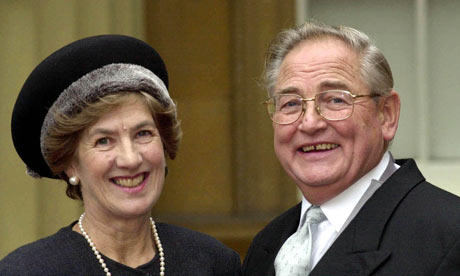
The former Bank of England governor Lord Eddie George died at the age of 70 today after a long battle with cancer.
Mervyn King, who succeeded him as governor, announced the death of the man nicknamed "Steady Eddie" and said he was "deeply saddened".
"He was an outstanding governor, colleague and friend,' he added.
"Eddie will be remembered as the governor who led the Bank to independence. Only a few weeks ago, we reminisced about the events that led to that significant change for the Bank.'
George retired in 2003 – making, in his own words, the transition "from Who's Who to Who's He?".
During his time at Threadneedle Street, he steered the Bank through the crisis of Black Wednesday and the collapse of Barings, chairing its rate-setting monetary policy committee from 1997.
Far from retreating to his Cornwall home after his retirement, however, George took on three private sector positions – as a non-executive director at the merchant bank NM Rothschild, a board member to Nestle and a non-executive director at the Duke of Westminster's property firm, Grosvenor Group Holdings.
However, at a conference last March, he admitted he was relieved to have resigned before the credit crisis.
"I used to be Bank of England governor, and I'm rather glad that I'm not today," he said.
Christened Edward Alan John George, he joined the Bank in 1962, at first working on East European affairs.
He was later seconded to the Bank for International Settlements and the International Monetary Fund.
In a tribute speech to the CBI after George's retirement, the then chancellor, Gordon Brown, told the story of how George once inadvertently helped himself from a bottle of scotch at a charity auction, only to discover that it was a 1937 vintage Glenfiddich that had been earmarked as the top prize.
Brown said that George, "in true central banker style", had nevertheless presented the bottle to the raffle winner and described it as half full rather than half empty.
Today, Brown said: "Eddie George was the first governor of the independent Bank of England.
"He was universally admired for his expertise, judgment and wisdom, and it was my privilege to have worked with one of the world's greatest and most respected central bankers. My thoughts are with [his wife] Vanessa and their three children."
The economist Will Hutton, the chief executive of the Work Foundation thinktank, said: "He was a complete professional, very approachable, a very good man. His particular pride was that he was the governor who navigated the bank to independence."
