
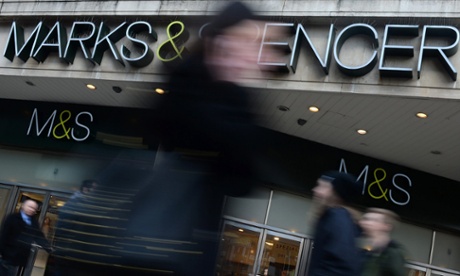
Marks & Spencer has unveiled another grim Christmas, with a big decline in sales of clothing and homewares, blaming distribution problems, mild weather and fierce discounting by rivals for its poor performance.
It is now four years since the retailer recorded any sales growth in its general merchandise departments and the latest decline will pile fresh pressure on the chief executive, Marc Bolland.
Shares in the high street bellwether slumped 3.5% to 447p as it revealed a 5.8% dive in underlying clothing and homewares sales in the three months to 27 December. The decline was much worse than analysts had expected. The food division also disappointed, with like-for-like sales – which exclude gains from new shopfloor space – up by just 0.1%.
Most of the damage was done by on-line sales, which tumbled nearly 6% as the group was dogged by problems at its hi-tech distribution centre in Castle Donington, Leicestershire, which opened 18 months ago. Bolland said: “We had a difficult quarter in general merchandise, dominated by unseasonal conditions and an unsatisfactory performance in our e-commerce distribution centre.”
M&S was forced to delay deliveries of online orders by up to two weeks before Christmas as it struggled to cope with a high sales over the Black Friday promotional weekend. Bolland said the company was now able to deliver to customers normally, but admitted M&S was still working on how it could improve the way it picked and packed goods to cope with complex multiple orders, like many of those received before Christmas.
“We are still continuing to upgrade Castle Donington and we will make sure we can meet peak demands like Christmas in the future,” Bolland said.
While analysts were unimpressed by M&S’s food sales, Bolland insisted the 0.1% rise was “a stunning result in a very difficult market”.
He insisted M&S’s customers were now much happier with the design of its clothing and blamed the warm weather and a heavy discounting on Black Friday for the majority of the fall in sales. “I’m very pleased with what the team is doing and I’m enjoying my role,” he said. “Our market share in cold weather trading, knitwear and coats, is higher than anyone and so we were hit more than others,” he said.
Bolland said he thought Black Friday had encouraged discounting on the high street but added that it was unrealistic to say clothing retailers should not get involved, as John Lewis boss Andy Street suggested earlier this month. “The market has been more promotional and that held us back. All over the place people were on sale,” he said. But he added: “I don’t believe we can stop Black Friday. It’s driven by the consumer and the fact that this country has a large dotcom market.”
M&S offered fewer promotions than in 2013. While that put off some shoppers, it meant it was able to increase its margins, so it remains largely on track to hit profit expectations. Tony Shiret, an analyst at BESI, said: “Given the tremendously difficult UK market conditions, this is a good result showing that problems have been grasped and that the sales weakness has not followed through into profit collapse as historically would have been the case.”
He said Bolland was trying to sort out long standing issues with its IT and distribution systems, and this was laudable. “There were bound to be problems along the way. He has probably been over-confident at times given the complexity and the scale of the task,” Shiret said.
Amid reports of continuing problems at Castle Donington, Jamie Merriman, an analyst at Bernstein suggested there may be more bad news to come: “We expect investors may be skeptical that e-commerce execution will be flawless from here,” she wrote in a note.
