
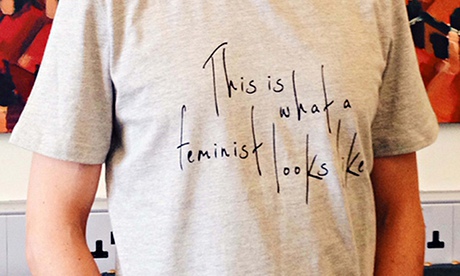
The Mail on Sunday has said that it stands by its story about conditions at a factory where the Fawcett Society’s “this is what a feminist looks like” T-shirts are made after the women’s rights charity rejected the claim that the garments were made in a sweatshop.
Responding after an outcry was sparked following the original report, the Fawcett Society said it had seen “expansive and current evidence” from the retailer Whistles that a Mauritius factory which made the T-shirts, worn by politicians including Harriet Harman and Ed Miliband, conformed to ethical standards.
However, the Mail on Sunday has hit back. A spokesman said: “The statements from the Fawcett Society and Whistles do not contradict a single fact that was published in the Mail on Sunday last weekend following observations, interviews and pictures obtained by our journalists who visited the factory last week.”
He said workers at the factory, owned on the island nation by Compagnie Mauricienne de Textile (CMT), are paid 62p per hour, earn the equivalent of one quarter of the country’s average monthly wage and sleep in bunk bed dormitories, 16 to a room.
“We spoke to one worker who sends all her money home to Bangladesh and has been too poor to return to see her family for four years,” he said.
“The president of the International Textile, Garment and Leather Workers Union described these conditions as ‘sweatshop’. We are advised that the government minimum wage in Mauritius is particularly low and that unions prefer to compare salaries to a ‘living wage’ which is more than double the pay offered by CMT. We are standing by our story 100%.”
Eva Neitzert, the deputy chief executive of the Fawcett Society, said the charity had seen evidence which “categorically refutes” the assertion that the T-shirts were made in a sweatshop. She said an audit into the CMT factory was carried out in October 2014 by an independent not-for-profit organisation and did not reveal any material concerns on the working conditions, the welfare or the health and safety of workers.
However, Fawcett was working with an international trade union body to examine the evidence so they could be “absolutely assured of its provenance, authenticity and that all findings are robust and factual”.
Whistles said it was committed to ethical sourcing policies and demanded the highest standards from its suppliers, carrying out regular audits of them, including unannounced visits and independent audits.
