
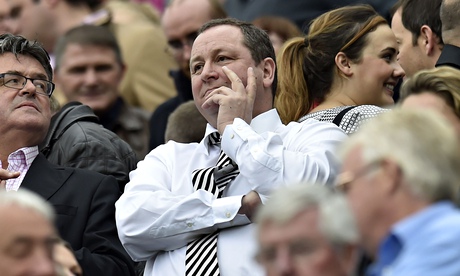
“This investment reflects Sports Direct’s growing relationship with Tesco and belief in Tesco’s long-term future.” The first half of this explanation for why Sports Direct is betting that Tesco’s shares will rise makes no sense. There is absolutely no need to “reflect” a trading relationship in this way. Even if there were, the natural method would be to buy shares directly and hold them loyally.
Instead, Sports Direct has entered a put-option agreement with Goldman Sachs that necessarily has a fixed expiry date. When the bet is settled – shareholders are not told when that will be – Sports Direct’s commercial relationship with Tesco, which amounts to a few shops-within-shops, won’t change one jot. Tesco’s board couldn’t give a damn if Mike Ashley’s outfit wins or loses its bet, or even if it ends up owning 0.28% of the supermarket chain’s equity.
This, then, is a straightforward punt, dressed up as a “belief in Tesco’s long-term future”. Yes, there’s an argument that Tesco’s shares – despite the accounting debacle, 75% dividend cut and falling profitability – represent decent value at half the price they were a year ago. But Mike Ashley’s punting record doesn’t inspire confidence: he lost a large sum (even for him) gambling on a recovery at the doomed HBOS.
At HBOS he was risking his own money. Fair enough. But the Tesco adventure is through Sports Direct. Ashley owns 58% of the company, but that doesn’t give him the right to use the business as a vehicle for speculation. The outside shareholders, led by hedge fund Odey (with 8%) and asset manager BlackRock (5%), are quite capable of forming their own opinions about the direction of Tesco’s shares which, incidentally, BlackRock has been selling.
Sports Direct investors, it might be argued, know these sorts of adventures come with the territory; in January, it was Debenhams, again via an option bet with Goldman Sachs. And £43m, Sports Direct’s maximum theoretical exposure on the Tesco option, is not a life-changing sum for a company worth almost £4bn. But what’s the limit on these gambles? Is there any level at which the supine non-executive directors would tell Ashley to use his own cash if he fancies a flutter?
GSK’s gain …
You don’t have to have a knighthood to be a senior director at GlaxoSmithKline, but most of them do. Sir Philip Hampton will next year replace Sir Christopher Gent as chairman; he will join chief executive Sir Andrew Witty after a search conducted by Sir Deryck Maughan, the senior independent director.
Gong considerations aside, GSK has chosen well. Hampton is a battle-hardened veteran whose six-year chairmanship of RBS, while far from perfect, was broadly a success. The big goal of returning the bank to the private sector has not been achieved and the strategic quarrels between former chief executive Stephen Hester and the Treasury festered for too long. But the bigger goal of detoxifying the balance sheet has largely been completed.
With hindsight, RBS should have been nationalised entirely in 2008 and split into a “good” bank and “bad” bank to boost lending to the economy. But the politicians’ failure was not Hampton’s fault. On the whole, he played a rotten hand skilfully. He also stayed the course, the first requirement of the job.
A measure of Hampton’s standing is that RBS hasn’t got a clue who will replace him. This is blamed on the fact that there’s a general election next May and any incoming chairman of an 81% state-owned bank would want to know who he, or she, is dealing with. Actually, the problem is deeper than that. Regardless of the government in office, who is both willing and qualified to chair RBS?
Big banks have to chaired by bankers these days and there aren’t many untarnished names that fit the bill. Barclays has just plucked John McFarlane from Aviva. The pool looks horribly dry.
This is also a problem for GSK since Hampton’s anointment as chairman may have to wait until September next year; the RBS post has to be filled first. Still, he will join the GSK board as a regular non-executive in January, and become deputy chairman in April, so he’ll be there in time to address the drug giant’s lingering Chinese woes.
A £300m fine for bribing doctors was announced last week but the matter doesn’t end there. The US department of justice and UK’s Serious Fraud Office are still investigating.
Then there’s the question of Witty’s bonus in the light of the damaging Chinese scandal. The board fudged the issue a year ago when the Chinese authorities were still investigating, making a small deduction to reflect reputational impact. Summoning the accumulated wisdom of his RBS years, Hampton should be able to provide a clear answer this time: why should there be a bonus at all?
More Mr Nice Guy
Michael O’Leary, fresh from his mission at Ryanair to stop “unnecessarily annoying people,” says he “would have been nicer years ago” if only he had realised it is good for business. He speaks as if it is a revelation that consumers have considerations beyond price. Come on, it was never a secret that many people hated the chaotic scramble for seats, for example.
Budget airlines only adopted the policy in the first place because they thought competition for seats was the quickest way to load a plane, a critical consideration when your business model depends on quick turnarounds. Once easyJet had proven that allocated seating gets bottoms on seats just as quickly, the old method had to go.
