
Just a quick update. European parliament president Martin Schulz (who met Greek prime minister Alexis Tsipras earlier) has given an interview with Germany’s Handelsblatt and is taking a pretty hard line (not sure whether the interview came before or after the Tsipras meeting, however):
- 04-Feb-2015 16:35 - EUROPEAN PARLIAMENT PRESIDENT SCHULZ SAYS IF GREECE UNILATERALLY ENDS ITS AGREEMENTS THE OTHER PARTIES ARE NO LONGER OBLIGED TO KEEP THEIR COMMITMENTS -GERMAN NEWSPAPER HANDELSBLATT
- 04-Feb-2015 16:36 - EU’S SCHULZ SAYS IN THAT CASE ATHENS WILL NO LONGER RECEIVE FUNDING AND THE STATE WILL NO LONGER BE ABLE TO FINANCE ITSELF-HANDELSBLATT
- 04-Feb-2015 16:38 - EU’S SCHULZ SAYS GREEK GOV’T HAS NO CHOICE BUT TO KEEP ITS OBLIGATIONS TO EUROPEAN PARTNERS
- 04-Feb-2015 16:42 - EU’S SCHULZ SAYS WE CAN FIND WAYS TO GIVE GREEK TREASURY ACCESS TO ASSETS BEING HELD ABROAD IN EU COUNTRIES AND IN COUNTRIES THAT HAVE TAX ACCORDS WITH THE EU
- 04-Feb-2015 16:44 - EU’S SCHULZ SAYS CAN ONLY TALK ABOUT GIVING GREECE CONCESSIONS IF THE GOV’T FULFILLS ITS COMMITMENTS TO EU PARTNERS
(Snaps courtesy Reuters)
Afternoon summary: Talks continue over Greek debt deal
So, a quick recap of this afternoon’s events.
Alexis Tsipras has met with Francois Hollance in Paris, as Greece continues to push for a debt deal.
The Greek PM urged France to help Europe’s economy recover, saying:
“We need a new accord in Europe for the return of growth and social cohesion, and in this effort we certainly need France playing a role of guarantor, a protagonist for this political change.....
“France is a force for stability in Europe, and I think the stability of the European Union requires a change of policy - a determined turn towards growth.”
President Hollande offered sympathy to Greece, saying it isn’t tolerable for austerity to be the only option.
But he cautioned:
“But there is also respect for European rules, which are imposed on everyone, France too, and it’s not always simple.”
The talks followed an earlier meeting between Tsipras and top officials in Brussels, where European Council chief Donald Tusk warned that negotiations will be tough.
Our lunchtime summary has all the details.
Tomorrow the spotlight will switch to Berlin. Finance minister Yanis Varoufakis has flown in (after a doze) ready to see Germany’s Wolfgang Schäuble.
Earlier, he held “fruitful” talks with the European Central Bank, but there’s still no word from the ECB on whether it will provide more help to Athens.
Germany is taking a hard line with Greece, though. A leaked document shows that the German government is pushing Athens to stick to its old austerity programme.
The IMF, meanwhile, has confirmed that its European chief met with Varoufakis over the weekend.
It was a quieter day on the Athens stock market.
The ATG index finished the day up 0.9%, adding to yesterday’s 11% surge. Bank stocks continued to recover - anyone who had the sense to buy shares last week, after they lost a third of their value, has done well.
And that’s probably all for today -- unless there are any more developments tonight....
All this frenzied negotiating must be exhausting, so it’s good to see that Yanis Varoufakis snatched a brief nap this afternoon.
Andreas Kynast, correspondent at German broadcaster ZDF, reported that Varoufakis took Lufthansa Flight 186 from Frankfurt to Berlin, and managed a brief rest en route (we trust no-one disturbed him).
Gewaltiges Pensum: Der neue griechische Finanzminister Varoufakis klappert Europas Hauptstädte ab. In der Economy. pic.twitter.com/sLcWrBWZFC
— Andreas Kynast (@andikynast) February 4, 2015
Varoufakis has now been collected by the Greek ambassador at Berlin Tegel Airport, ready for his appointment with German finance minister Wolfgang Schäuble on Thursday morning.
Flughafen Berlin-Tegel: Griechenlands Botschafter holt Economy-Passagier Vanoufakis ab. Morgen Termin bei Schäuble. pic.twitter.com/QEsTHwBI6o
— Andreas Kynast (@andikynast) February 4, 2015
They’re hardly natural soulmates, but Yanis Varoufakis and the Adam Smith Institute are best buddies after the right-wing thingtank threw its weight behind a Greek debt deal.
Varoufakis tweeted his thanks a little while ago:
We live in a strange world: "Adam Smith Institute calls on Osborne to back Varoufakis's Greek debt-swap plan" http://t.co/aaReZf2EPF
— Yanis Varoufakis (@yanisvaroufakis) February 4, 2015
... in the sense that I never thought the Adam Smith Institute would endorse anything that comes from me. Still, profuse thanks folks at ASI
— Yanis Varoufakis (@yanisvaroufakis) February 4, 2015
Greece: What the analysts say
Some afternoon reading...
- Will other Eurozone countries and the IMF agree to the bond swap? It will mostly depend on how the mechanism envisaged by Varoufakis works in practice. If, for instance, the repayment of the new bonds is linked to nominal GDP growth and the targets are too ambitious – especially since Greece is currently in a deflation – would creditors see it as a write-down in all but name?+
- Will SYRIZA stick to its guns and refuse to extend Greece’s bailout programme? It’s too early to tell, but this is a fundamental point – especially since the ECB has said it would cut off liquidity to Greek banks unless the Greek government agrees to extend the programme, with all the conditions attached, beyond the 28 February deadline.
Did SYRIZA just blink and give up on debt write-down demands? My latest on the @OpenEurope blog: http://t.co/KZwpOuNpbp #Greece #Varoufakis
— Vincenzo Scarpetta (@LondonerVince) February 4, 2015
While Sony Kapoor of ReDefine reckons we should cut Syriza some slack:
Despite several unsubstantiated rumours and sometimes deliberate, attempts to discredit a popular new government, Syriza has done a fairly decent job despite having no previous experience of governing whatsoever. It has not stepped on any nuclear mines, nor done irreparable harm to either its domestic or international standing. Yes it has had a somewhat rocky start but that was to be expected in such turbulent times and stressed conditions.
Syriza has done the Eurozone a great service by finally forcing it to start a debate on a number of critical issues that Frau Merkel, dubbed by the Economist as the West’s “greatest ditherer”, has so far declined to discuss.....
Which "radical left" govt promises a perpetual budget surplus? It's time 2 call #Syriza centrist! http://t.co/00w276Ner0 via @sharethis
— Sony Kapoor (@SonyKapoor) February 4, 2015
Updated
Hollande's line with Tsipras: Sympathetic on austerity but stresses need to follow rules, stick to commitments. pic.twitter.com/YWR3nHn7Uo
— HU Yihan (@yihan_hu) February 4, 2015
At first sight, #Hollande much “warmer" than #Renzi with #Tsipras. #Greece
— Mattia Guidi (@matguidi) February 4, 2015
Tsipras also insists that Greece’s debt burden must be made ‘viable’.
No questions from the press, though.
Tsipras-Hollande press conference is over. pic.twitter.com/KYGxl8yt65
— Thomais Papaioannou (@ThomaisERT_RIK) February 4, 2015
Tsipras and Hollande speak after meeting
Alexis Tsipras and Francois Hollande are holding a press conference now:
Hollande n Gespräch m Tsipras: Wahlen in Griechenland zeigen, dass Austerität nicht einzige Option sein kann pic.twitter.com/JJox0WvWCv
— Paul Ronzheimer (@ronzheimer) February 4, 2015
Tsipras is repeating some of the point he’s made in earlier meetings -- that Greece needs growth, not austerity, and that he wants a deal that helps all of Europe.
My government is an opportunity for Europe to move forwards, not a threat, he insists.
- GREECE’S TSIPRAS, AFTER TALKS IN PARIS WITH HOLLANDE, SAYS CHANGE OF POLICY TOWARDS GROWTH IS NEEDED FOR STABILITY OF EU
- TSIPRAS SAYS FRANCE MUST PLAY KEY ROLE IN THIS CHANGE OF POLICY
- TSIPRAS - NEW GREEK GOVT IS NOT A THREAT TO EUROPE, IS AN OPPORTUNITY
- TSIPRAS - WE HAVE MADE “REALISTIC” PROPOSALS THAT CAN LEAD TO AN AGREEMENT
Hollande is also speaking, expressing sympathy with Greece but also talking about sticking to the rules.
LIVE : #Tsipras in Paris - Hollande: 'Greece wishes to stay in the #Eurozone' http://t.co/FGOS39lBgt pic.twitter.com/rn8ScRrLEb
— FRANCE 24 English (@France24_en) February 4, 2015
Hollande takes similar line to Renzi with Tsipras: Sympathetic on austerity but stresses need to follow rules, stick to commitments. #Greece
— Open Europe (@OpenEurope) February 4, 2015
Alexis Tsipras headed off to Paris after his talks in Brussels, to see fellow left-winger Francois Hollande.
Tsipras meets President Hollande in Paris - PHOTO - http://t.co/vNqfBZN7pt pic.twitter.com/T3H8HAQKjJ
— enikos_en (@enikos_en) February 4, 2015
On a lighter note, Ladbrokes are now taking bets on whether Greece’s prime minister is spotted wearing a tie in 2015.
They reckon it’s unlikely. You can get 6/4 that Alexis Tsipras smartens up, and only 1/2 that he doesn’t.
Remember, the official line is that Tsipras will only wear a tie once he’s secured a debt deal.
Germany draws battlelines over Greece
A confidential document has dropped into Reuters’ clutches, showing that Germany is refusing to accept Alexis Tsipras’s demands.
The document was drawn up ready for a meeting of senior eurozone finance officials on Thursday. It outlines that Berlin will not tolerate any ‘rolling back’ of the existing austerity, despite Syriza’s victory in last month’s general election.
Reuters says:
The German document stressed that Athens must not roll back any of the cutbacks and reforms made so far in Greece’s efforts to improve bloated public finances and regain market trust.....
“The Eurogroup needs a clear and front-loaded commitment by Greece to ensure full implementation of key reform measures necessary to keep the programme on track,” the German document said, referring to euro zone finance ministers.
“The aim is the perpetuation of the agreed reform agenda (no roll back of measures), covering major areas as the revenue administration, taxation, public financial management, privatisation, public administration, health care, pensions, social welfare, education and the fight against corruption.”
*GERMANY WANTS GREECE TO DROP ANTI-AUSTERITY PROMISES: REUTERS
— Dealingroom (@Dealingroom_EN) February 4, 2015
The FT’s Peter Spiegel has confirmed that Greece’s finance minister had a chat with International Monetary Fund heavy-hitter Poul Thomsen over the weekend.
I've been told by 2 reliable sources that @yanisvaroufakis met with #IMF European dept chief Poul Thomsen while he was in Paris on Sunday.
— Peter Spiegel (@SpiegelPeter) February 4, 2015
MT @SpiegelPeter I'm told Varoufakis-Poul Thomsen meet was simply a "get to know you" session to lay groundwork for future talks
— Yannis Koutsomitis (@YanniKouts) February 4, 2015
The Greek finance ministry has now confirmed the meeting.
Poul Thomsen used to head the Troika’s delegation to Greece, before being recently promoted to run the Fund’s European division.
Updated
Alexis Tsipras has received the seal of disapproval from satirical rag Private Eye:
PRIVATE EYE: Greece and EU debt crisis talks #tomorrowspaperstoday pic.twitter.com/bRyxi5UHqK
— Neil Henderson (@hendopolis) February 4, 2015
Available at all good newsagents.
Lunchtime summary: Greece upbeat after talks
The two men leading the battle to renegotiate Greece’s debts have claimed some success after a round of crunch meetings today.
Yanis Varoufakis, Greece’s finance minister, says he had “fruitful” conversations with European Central Bank president Mario Draghi. He told reporters that:
“The ECB is the central bank of Greece ... The ECB will do whatever it takes to support the member states in the euro zone.”
“I have no doubt that we can conclude our discussions with our European partners, as well as with the IMF and the ECB, in a very short space of time so that we can kick-start the Greek economy.”
But there’s no official response from the ECB yet, which is under pressure from Athens to give it permission to borrow more money while negotiations take place.
Prime minister Alexis Tsipras also pressed the flesh in Brussels today, meeting European Commission chief Juncker, Council president Donald Tusk and Parliament head Martin Schultz.
After being led away by the hand by Juncker, Tsipras reappeared to declare that he will respect his voters wishes and the framework of the EU:
I am very optimistic that these discussions that were in a good way - of course we don’t have already an agreement - but were in a good direction to find a viable agreement.”
However, Tusk was more cautious, saying after the meeting that negotations would be difficult.
Seems like it's all smiles and handshakes as the #Greek leaders press the flesh around the EU. Only #Tusk spoke of potential difficulties.
— Peter Oliver (@PeterGOliver_RT) February 4, 2015
And Angela Merkel has denied that Germany is out on a limb on the issue. The chancellor told a news conference in Berlin that there’s no substantial difference of opinion among eurozone members over Greece.
Greek bonds have fallen in value, pushing up the yield on the debt, as investors remain cautious about the prospects of a restructuring.
After a weak start, the Athens stock market has turned positive and is currently up 2.2%. Bank shares are continuing to recover. Other European markets are down, though.
The ECB is due to decide this afternoon whether to continue to allow Greek banks to access funds through its emergency liquidity assistance for another fortnight.
Updated
Jarno Hartikainen of Finnish newspaper Kauppalehti reckons that Tsipras has been told to stop negotiating through the press...
Seems the main message from Juncker & Tusk to Tsipras was: yes, let's discuss, but NO MORE through media #Greece
— Jarno Hartikainen (@JarnoHa) February 4, 2015
A volley of newsflashes from the German chancellor (and the Maltese PM):
- MERKEL SAYS WE STICK TO OUR POLICY THAT GREECE SHOULD REMAIN IN THE EURO ZONE
- BERLIN-MALTA’S PRIME MINISTER MUSCAT SAYS IS AGAINST A DEBT REDUCTION FOR GREECE BUT OPEN TO DEBATE ON CONDITIONS
- MERKEL SAYS LOOKS FORWARD TO MEETING TSIPRAS AT EU SUMMIT NEXT WEEK
- MERKEL SAYS I SEE NO DIFFERENCE “IN SUBSTANCE” WITH OTHER EURO ZONE STATES’ VIEWS ON GREECE
Donald Tusk: Greek talks will be difficult
Here’s the official statement from European Council chief Donald Tusk, warning of difficult negotiations ahead:
I was pleased to welcome Greece’s new Prime Minister Alexis Tsipras in Brussels today. Our talks were open and frank on a number of issues of common concern.
As regards European financial assistance to Greece, I stressed the need to find a solution acceptable to all Member States involved in the negotiations. Those negotiations will take place in the euro group. They will be difficult, will require cooperation and dialogue as well as determined efforts by Greece.
We agreed on the importance of unity within the European Union with regard to other key challenges facing Europe.
My statement after meeting Prime Minister @atsipras of #Greece today: http://t.co/PkaiqmJY5U. #euro #EUCO pic.twitter.com/cEab3FDHDn
— Donald Tusk (@eucopresident) February 4, 2015
European Council chief Donald Tusk has warned that talks between Greece and the rest of the eurozone will be “difficult”, following his meeting with Alexis Tsipras.
Alexis Tsipras’s message from Brussels is that Greece can get a debt relief deal with its partners, without shattering the European Union.
He sounded optimistic after meeting European Commission President Jean-Claude Juncker, European Council President Donald Tusk and European Parliament President Martin Schulz.
Tsipras said:
I’m very optimistic that we will try to do our best in order to find a common, viable and mutually acceptable solution for our common future....
“Our goal is to respect the people’s sovereignty in Greece and the clear mandate of our people. At the same time we respect the rules of the European Union. We want to recorrect this framework, not to smash this framework and we believe that in this framework we could find a common viable solution.
“I am very optimistic that these discussions that were in a good way - of course we don’t have already an agreement - but were in a good direction to find a viable agreement.”
Tsipras gives press conference in Brussels
#NOW #press #point @EP_President @MartinSchulz & @PrimeministerGR @atsipras. @SYRIZAEP http://t.co/RmRV4U0R30 pic.twitter.com/4a1SnVBFLE
— Ευρωκοινοβούλιο (@EP_Hellas) February 4, 2015
Heads-up: Greece’s prime minister is giving a press conference in Brussels now.
Alexis Tsipras says that Greece doesn’t have a deal yet, but reckons “we are moving in the right direction”
He says “We have the will to work to find a mutually acceptable compromise with the EU”, and promises to respect European rules.
Tsipras says gov't has plan of sweeping reforms to deal with domestic causes of crisis, i.e. corruption, vested interests, tax-evasion
— Kathimerini English (@ekathimerini) February 4, 2015
More to follow....
Berlin-based journalist Peter Oliver reckons Varoufakis’s meeting with Wolfgang Schauble tomorrow will be tough.
#Greece may be looking for some allies before tomorrow's finance ministers meeting in #Berlin. Word on the street is it won't be pleasant.
— Peter Oliver (@PeterGOliver_RT) February 4, 2015
#Greek Finance Minister Yanis #Varoufakis calls the ECB “the central bank of Greece”. Appears in buoyant mood after meeting Draghi.
— Peter Oliver (@PeterGOliver_RT) February 4, 2015
The main Greek stock index has now dropped by 2%, as traders take a more cautious view after yesterday’s 11% surge.
Varoufakis: We can get a deal quickly
Yanis Varoufakis struck an optimistic tone after his meeting with Mario Draghi.
The Greek finance minister told reporters shivering outside the ECB headquarters that he believes discussions with international lenders can be concluded quickly.
Varoufakis said:
“The ECB is the central bank of Greece ... The ECB will do whatever it takes to support the member states in the euro zone.”
“I have no doubt that we can conclude our discussions with our European partners, as well as with the IMF and the ECB, in a very short space of time so that we can kick-start the Greek economy.”
(quotes via Reuters)
Tomorrow’s meeting with Germany’s finance chief Wolfgang Schäuble will be a big test, though. The suspicion is that Berlin will want to play a long game with Greece, and see signs of economic reform before loosening the ties of austerity.
In other news...China has just eased monetary policy, in the face of its slowing economy.
It has cut the reserve requirements on its banks, meaning they have to carry less capital on their books.
China cuts Reserve Requirement ratio for banks by 0.5% in face of ongoing capital outflows, econ slowdown. Next up rate cut again .
— George Magnus (@georgemagnus1) February 4, 2015
Sounds like Varoufakis got a warmer reception inside the ECB than the media pack experienced outside:
Greek Fin told freezing journalists in Frankfurt that it can't be "business as usual", said he had a "fruitful" talk with Draghi.
— Todd Buell (@ToddBuell) February 4, 2015
@yanisvaroufakis said "I had a constructive meeting with #Draghi ". In my job "constructive" means we need at least 3 more mtgs #Greece
— Stefanos Fotiou (@stefanosfotiou) February 4, 2015
Political scientist Ian Bremmer predicts a long haul....
Greek Finance Minister 'encouraged' by talks with ECB. This is going to be a very long road.
— ian bremmer (@ianbremmer) February 4, 2015
Greece has just been forced to pay a higher rate of interest, at an auction of short-term debt.
The Athens debt office just sold €812m of 26-week Treasury bills (debt that matures in six months), at a yield (interest rate) of 2.75%, up from 2.3% before.
That shows that investors want a higher rate of return for holding Greek bonds.
The auction also drew rather fewer bids than usual. This pushed down the bid-to-cover rate to its lowest in eight and a half-years.
#Greek bill auction bid to cover ration lowest since July 2006
— Francine Lacqua (@flacqua) February 4, 2015
The Wall Street Journal has confirmed that Greece has started talks with the International Monetary Fund over an extension to its bailout programme:
Greece starts debt repayment talks with the IMF http://t.co/WJ0rm3vNQM pic.twitter.com/Dsrmcv0SeD
— Wall Street Journal (@WSJ) February 4, 2015
Yanis has left the building....
Updated
Yanis Varoufakis also told Draghi that the Greek austerity programme has been driving the country into “a deflationary crisis”.
Varoufakis: I had a fruitful exchange with Draghi
Newsflashes from Frankfurt -- Yanis Varoufakis is telling reporters that he had a ‘fruitful’ meeting with ECB Mario Draghi.
He also said he is “eager” to meet with Germany’s finance minister, Wolfgang Schäuble, tomorrow.
#Greece FinMin Varoufakis says he had 'fruitful exchange with Draghi; says Draghi outlined how #ECB supports #euro area. /via @advdesk
— Yannis Koutsomitis (@YanniKouts) February 4, 2015
*VAROUFAKIS: IT WON'T BE BUSINESS AS USUAL IN GREECE
— Michael Hewson (@mhewson_CMC) February 4, 2015
Updated
Britain’s companies have also made a decent start to 2015.
Markit’s all-sector PMI, which tracks thousands of UK companies, rose to 56.9 in January, showing faster growth than in December.
Eurozone PMIs - more and more good news means France's underperformance becomes even more striking.
— Frederik Ducrozet (@fwred) February 4, 2015
Good news for eurozone policymakers to ponder -- the region’s service private sector is growing at its fastest rate in six months.
Markit’s monthly PMI survey shows that activity in the eurozone picked up pace in January, making a “positive start” to 2015. But France was the big disappointment; the only member of the Big Four economies not to post growth.
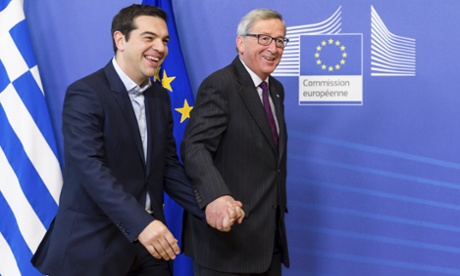
Apparently there was laughter in Brussels a few minutes ago as Commission president Juncker led the new Greek PM off by the hand to their meeting.
Photo of Juncker and Tsipras walking hand-in-hand ahead of talks at the European Commission [Reuters] #Greece pic.twitter.com/YUVJ0AvStp
— Kathimerini English (@ekathimerini) February 4, 2015
It’s not his first day at school, Jean-Claude!
Frankfurt reporters are poised for a sighting of Yanis Varouvakis inside the ECB....
Waiting for Varoufakis in the @ecb lobby. To set the mood, the name of the cafe means "a bit sour" pic.twitter.com/3KUZqvyEmn
— Alessandro Speciale (@aspeciale) February 4, 2015
Jim O’Neill: Greece will get a debt deal
Jim O’Neill, the UK economist who invented the idea of the BRICs economies, is optimistic that the worst of the Greek crisis is over.
He’s on Bloomberg TV now, predicting that:
Some time in the last week a decision has been taken that Greece is going to stay in the eurozone -- so there’s going to be a deal.
That’s his hunch, rather than any inside information.
O’Neill argues that it’s “just stupid” to think that Greece could repay a debt that equals 175% of its GDP. And it “doesn’t make sense” to imagine that Germany will allow a bank run in Greece, or the break-up of European Monetary Union.
Greece 'opens talks with IMF' over debt swap
Back to Greece....and Yanis Varoufakis has revealed that Athens has opened talks with the IMF over his debt swap proposal.
Reuters has the details:
Greece has started negotiations with the International Monetary Fund over its plan to swap existing government debt for growth-linked bonds, finance minister Yanis Varoufakis told Italian newspaper La Repubblica in an interview published on Wednesday.
Varoufakis also said he was optimistic that the Greek debt problem would be solved and had received good feedback during meetings with financiers in London on Monday.
The FT also reports that the meeting between the left-wing economist and City investors at the Four Seasons Hotel on London’s Park Lane went surprisingly well.
The investor presentation, organised jointly by Deutsche Bank and Bank of America Merrill Lynch, was followed by a series of more informal conversations with small groups of investors.
“He made a real effort,” said one banker. “He stayed back to talk to investors. That went down well.”
Updated
More data....and Germany’s service sector has posted pretty decent growth in January, according to Markit:
#Germany Services Business Activity Index at 54.0 in Jan (52.1 in Dec), Composite Output Index at 53.5 (52.0 in Dec) http://t.co/ChsrJPCejA
— Markit Economics (@MarkitEconomics) February 4, 2015
The latest eurozone data paints a mixed picture. Italy’s service sector posted faster growth than expected in January, but France was a little weaker than expected
Italy Services PMI (Jan) jumps to 51.2, above expectations of 50.
— Michael Hewson (@mhewson_CMC) February 4, 2015
France Services PMI (Jan) comes in at 49.4, below expectations of 49.5
— Michael Hewson (@mhewson_CMC) February 4, 2015
(any reading below 50 = contraction)
Just in: a photo of Yanis Varoufakis arriving in his (“slightly rusty”) Mercedes for talks with Mario Draghi, a few minutes ago.
Alexis Tsipras meets Juncker for talks
It’s all go this morning. Greek prime minister Alexis Tsipras has just shaken hands with Commission chief Jean-Claude Juncker in Brussels.
The pair smiled for the cameras, but they look pretty tense...
Not very happy guys... #Tsipras #Juncker pic.twitter.com/aDFOw5GD8M
— Yannis Koutsomitis (@YanniKouts) February 4, 2015
It’s disappointing that Tsipras hasn’t given his new tie a run-out -- clearly he’s saving it until Greece has a debt deal.
RT @yanpal7: @JunckerEU, after official snaps, takes @atsipras by the hand and they walk off. Greek media commentators go berserk.
— Efthimia Efthimiou (@EfiEfthimiou) February 4, 2015
Updated
Yanis Varoufakis has just arrived at the ECB’s headquarters for today’s meeting with Mario Draghi.
Bloomberg’s Jeff Black reports that the finance minister has plucked a black shirt from his suitcase today:
#Varoufakis arrives at #ECB in a slightly rusty Mercedes. Black shirt today. #importantdetail
— Jeff Black (@Jeffrey_Black) February 4, 2015
Greek stocks and bonds fall
The Greek stock market has just fallen 1% at the start of trading in Athens, mirroring the decline in bond prices.
Not really a surprise – yesterday the ATG index surged by a remarkable 11%, on optimism over Greece’s debt swap plan. Even though it’s not been agreed by the main powerbrokers in Europe, or even discussed with them...
After a storming day yesterday, Greek bonds are weakening a little this morning.
That follows the FT’s report overnight that the ECB will play hardball with Athens’ new government.
The yield (or interest rate) on Greek 10-year bonds has pushed back over the 10% mark (yields rise when prices fall).
#Greece yields after European markets opening 3y 16.85%; +56 bps 5y 13.26%; +27 bps 10y 9.96%; +48 bps 15y 10.22%; +24 bps
— Advisory Desk (@advdesk) February 4, 2015
Syriza government's biggest test as #Varoufakis meets #ECB president #Draghi in Frankfurt today. #eurocrisis #greece
— Omaira Gill (@OmairaGill) February 4, 2015
The European Central Bank is also deciding today whether to allow Greek banks to tap its ELA liquidity facility for another fortnight.
They’ll probably give the green light. But the meeting underlines how precarious Greece’s banks have become, especially as the ECB could block Greece from the ELA if its bailout deal expires on 28 February.
Mike Bird has a good explanation on Business Insider:
3 Greek meetings today: ECB decide whether to extend ELA, Juncker vs. Tsipras, Draghi vs. Varoufakis. http://t.co/LcTnYNTYCr
— Mike Bird (@Birdyword) February 4, 2015
The ECB press office won’t say when the Varoufakis-Draghi meeting is taking place, beyond sometime this morning.
They’re not holding a press conference afterwards (alas), so we’ll have to rely on leaks from the two sides afterwards.
Greece’s prime minister is also holding an important meeting today.
Alexis Tsipras is due to see European Commission chief Jean-Claude Juncker in Brussels this morning. Perhaps he could wear that nice tie which Italian PM Mattei Renzi handed over yesterday, to his fellow left-wing leader.
Italian PM Renzi told new Greek PM Tsipras that he was a 'blessing' because it meant Renzi was no longer Europe's number 1 'dangerous lefty'
— Gavin Hewitt (@BBCGavinHewitt) February 4, 2015
Greek finance minister takes debt fight to Germany
Good morning.
The master of game theory is taking on the poker-faced saviour of the euro today, as Greece’s battle for a new debt deal reaches Germany.
Finance minister Yanis Varoufakis will meet with Mario Draghi this morning, in Frankfurt. The former economics professor will be pushing his plan to swap some Greek debt for new bonds linked to growth, to help Greece break its “debt addiction”.
Varoufakis is reluctant to give full detail of his plan, telling reporters in Rome yesterday that:
“This is not the time for financial-engineering lectures”.
But he’ll need to play his cards like a pro against Draghi, in perhaps the most serious test of the eurozone since the ECB president pledged to do “whatever it takes” to protect the single currency.
The ECB holds a lot of power over Greece, and it intends to use it. Last night, it emerged that the Bank would block Greece’s application to borrow an extra €10bn in short-term loans to tide it over.
“The Greek plan relies fully on the ECB,” said another eurozone official briefed on the talks. “The ECB will play hardball.”
FT UK: ECB's 'hardball' stance threatens to leave Greece without funding #tomorrowspaperstoday #BBCPapers pic.twitter.com/IfGI6JcM49
— Neil Henderson (@hendopolis) February 3, 2015
#ECB scuppers #Greece rescue plans by refusing to supply short-term credit line while deal reached. More hawkish than #EU Govs. Want reform.
— Robin Bew (@RobinBew) February 4, 2015
The ECB also has the power to pull the plug on Greece’s banks, by cutting them out of its liquidity programme on 1 March if there isn’t a bailout deal. That would be a nuclear decision – not one Draghi would take lightly – but it’s on the table.
We’ll be tracking the action in Frankfurt, and other events across the financial markets, the world economy and business through the day....
Updated
