
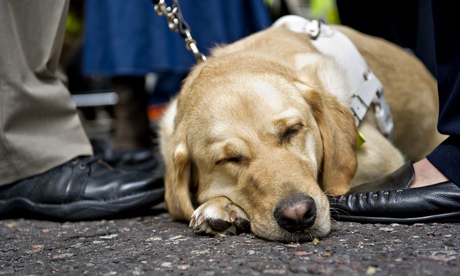
Tesco hit the headlines last month when staff asked a blind woman with a guide dog to leave the shop. Maya Makri said she was shouted at by three cashiers, who told her “no pets allowed” and to leave the shop.
Small businesses can avoid similar situations by ensuring their staff know how to identify guide dogs and understand the rights offered to guide dog and assistance dog users by the Equality Act 2010.
Guide Dogs UK have received nearly 500 complaints about access problems in the last year – and that’s just from the people who took the effort to complain. As president of the European Guide Dog Federation I am in touch with guide dog users and trainers all over Europe and I see a wide range of different practices. Plus, as a guide dog user since 2010 – I suffer from a condition called Retinitis Pigmentosa – I experience reactions of small businesses first hand.
What to do when a guide dog enters your business
If a dog comes into your business premises, welcome the owner but don’t fuss the dog– they can get a little bit excited if they are fussed. If the dog rushes towards a welcoming proprietor, and there is a step between you and the guide dog owner, the results can be catastrophic. Let the dog lead the owner. Don’t say “there are two steps coming up” when the steps are leading down. The dog will tell its owner if there are steps.
Examples of guide dog friendly small businesses
If you run a restaurant or café, don’t feed the dog – they are kept on a very strict diet and feeding the dog can distract it from its duty. The dog is trained to curl up at its owner’s feet and stay well out of the way until the meal is over. However, you might want to offer a drink, as a working dog can get quite thirsty on a busy morning’s shopping trip. I found Prague the most dog-friendly city in Europe; every time I went into a restaurant they asked me if my dog, Zoey, would like a drink.
I was once in a café in Anglesey after an energetic morning with Zoey, running up and down the beach. She obviously ate something unpalatable because in the cafe an hour or so later she coughed up seaweed. The owner put us at our ease by arriving with a big pack of tissues.
Be aware of how to identify a guide dog
No business owner would dream of saying “you can’t bring your child in”. It should be the same with trained dogs. As well as the nearly 4,900 guide dogs in the UK, there are an increasing number of assistance dogs that help other disabled people. There are dogs that help people in wheelchairs and with other medical conditions and dogs for deaf people.
All these dogs are trained to a certified standard and can be recognised by their distinctive jacket, quite apart from their good behaviour. Assistance Dogs UK has developed an identity card which is being issued this year. So, if in doubt, the proprietor can ask for positive identification.
In my experience, most customers are affectionate towards guide dogs and their presence adds a warm glow wherever they are. In short, assistance dogs and guide dogs are good for business.
David Adams is the president of the European Guide Dog Federation
Read more stories like this:
How to build a business community
Small business owners should not be afraid to ask for advice
This content has been sponsored by Kia Fleet, whose brand it displays. All content is editorially independent.
Sign up to become a member of the Guardian Small Business Network here for more advice, insight and best practice direct to your inbox.
