
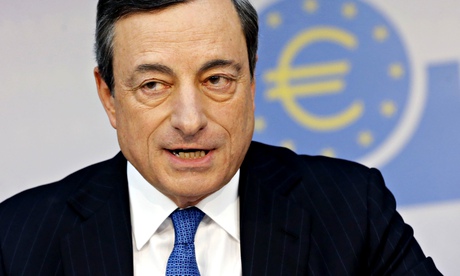
The European Central Bank's flagship scheme to boost the eurozone economy has received a lukewarm welcome from banks in the 18-state single-currency area.
Financial markets were taken aback to find only limited demand for the cheap credit on offer from the ECB, as they had expected institutions to snap up the cut-price loans.
The ECB, led by Mario Draghi, had made €400bn (£315bn) available for TLTROs (targeted long-term refinancing operations) under which banks could take out loans at an interest rate of 0.15% for four years provided they increased lending to businesses or households, and for two years whether or not they increased lending.
The ECB announced Thursday that banks had taken up only €82bn of the €400bn – about half the figure that had been expected in the markets.
Another tranche of money will be available in December, and some analysts predicted demand might be stronger in three months. The TLTROs are similar to the Bank of England's funding for lending scheme, which got off to a slow start when it was launched in August 2012.
However, some economists believe the lack of take-up for the TLTROs will force the ECB into more drastic action, including buying government bonds under a quantitative easing programme.
"The consensus expectation in a survey of economists had been for an uptake of €150bn and even that would have been some way below the sums that the president, Mario Draghi, has suggested that he would like to see," said Jennifer McKeown, senior European economist at Capital Economics.
"But the fact that banks have borrowed relatively little suggests that they have little intention of increasing their lending, either because of their own risk aversion, a lack of demand for loans, or most likely both."
The German finance minister, Wolfgang Schäuble, expressed scepticism this week about whether any action by the ECB would prove to be the cure for the eurozone economy after growth came to a halt in the second quarter of 2014.
"It's no good to hold the central bank responsible for growth and jobs – it's doing what it can but it has basically exhausted its tools, as you can see from current developments," he told the German Bundestag on Tuesday. "Cheap money can't force growth either – otherwise we'd have no problems now," he said.
