
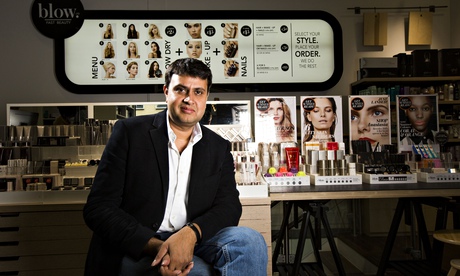
Dharmash Mistry, one of the newest members of the BBC's executive board, was brought in, according to the corporation's director general, Tony Hall, for his experience in a range of businesses and his extensive knowledge of digital development. His current day job is his new venture, bringing "salon-beautiful hair" to the people.
The combination might sound unlikely but Mistry, 44, is the co-founder of Blow, a beauty retailer that reinvents the traditional salon as a "fast beauty bar", with a philosophy forged like an internet business.
"Our business is reinventing Space NK," says Mistry of the company that reels in busy, image-conscious women with the promise of a "30-minute blow". You can also get professional-looking war paint applied in 15 minutes.
"We're not a hairdresser," Mistry insists. "At its heart Blow is a consumer internet company. You're not cheating on your hairdresser by coming to us." Blow dispenses with small talk about holidays in favour of ruthless efficiency.
"You book a slot, not a person," he says. "You book a 7.30 appointment and we guarantee you leave at 8. All our learnings are from the restaurant market not salons. The [hairstyle] menu is like a sushi menu of end looks."
Perhaps aided by his degree in engineering, economics and management from Oxford University, Mistry has broken down a trip to the salon in the same way McDonald's regimented burger flipping. It drills junior hairdressers – more experienced ones have too many bad habits – into how to create looks such as the "faux blow" or "starlet blow" with each style broken down into 20 minute-by-minute steps. Clients have their hair and nails done at the same time.
Blow, which opened its first salon in London's Covent Garden last year, takes its cue from undercutting tech companies, such as US shaving-gear website Harry's, which is taking on Gillette with its low-cost razors. Mistry met hundreds of tech entrepreneurs while globetrotting during a four-year stint at private equity firm Balderton Capital where he oversaw investments such as LoveFilm – now part of Amazon – the online retailers Achica and My Wardrobe and the music streaming firm Mog, which was sold to the headphone-maker Beats.
Mistry's business partner is Fiona McIntosh, launch editor of Grazia magazine, and the pair have attracted investors to stump up $9m (£5.5m) to kickstart the business, among them Asos co-founder Nick Robertson, Mark Sebba, former chief executive of Net-A-Porter, and Lion Capital owners Robert Darwent and Lyndon Lea, whose other investments include American Apparel, All Saints and hair straightener maker GHD.
Before his stint at Balderton, Mistry was part of the management team that sold Emap's consumer magazine business to Bauer for £1.1bn. During his eight years at Emap, Mistry held a range of executive roles and shut down the cult music magazine The Face and launched lads' title Zoo. "There are lots of hard calls in business," he says of the decision to close The Face. Of his post at the BBC, Mistry says: "They [the BBC] are interested in me being a digital guy … Over the past six years I've seen entrepreneurs from around the globe and pretty much every deal globally from Twitter and Spotify down being pitched."
Blow's clients can be broken down into three groups: high-fliers; office workers and so-called "yummy mummies". The salon opens at 7am and up to 20% of its trade is packed into the next two hours. "What we sell is a shot of confidence," Mistry says. "From the senior partner at a law firm who needs to look good before a meeting to her secretary [for whom] it's a substitute for lipstick in the office bathroom before going out on a Thursday or Friday night."
A second salon will open in Canary Wharf this autumn with a third, targeting those yummy mummies, to follow next year. For the latter it is scouting London high-street locations near private girls' schools and premium postcodes. Mistry, who grew up in Hampstead and is an Arsenal season-ticket holder, says his wife is a Blow fan. "All the school mums are," he says.
The founders believe Blow will end up being subscription-based, like a gym, a setup already seen in the US where the fast-growing chain Drybar promises members two "blowouts" and other discounts for $75 a month. With appointments booked online and regular email contact with its customers, the lion's share of sales will come from its website which sells 70 high-end makeup, skin and haircare brands ranging from Kérastase to Laura Mercier.
"The stores are about experience and data collection but most of the sales will happen online," he says. "The people who do fast beauty are the biggest beauty consumers and spenders in the market. An average woman spends £1,500 a year on beauty but these women spend significantly more."
