
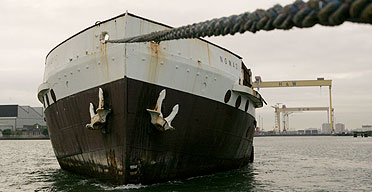
The SS Nomadic may be a leaking hulk saved from the breakers' yard but she is laden with commercial potential for reviving interest in popular maritime history.
The last floating link to the sinking of the Titanic, the 230ft-long, rusting tender could soon have a starring role in the £1 billion regeneration of Belfast's docks and waterfront.
As ceremonies were held this week to mark the 95th anniversary of the sinking of the Titanic, the Nomadic was opened up to the public.
The ship was built at Harland and Wolff's shipyard for the White Star Line in 1911, in the same docks and at the same time as the ill-fated cruise liner.
Once completed, the Nomadic was sent to the French port of Cherbourg where her function was to ferry first and second-class passengers from the quayside to waiting cruise White Star ships that were too large to enter the harbour.
Nomadic took around 140 passengers out to the Titanic for the liner's only trans-Atlantic voyage.
The collision with an iceberg on April 15 1912 and the catastrophic loss of 1,522 lives on the ship's maiden voyage transfixed the popular imagination.
Attempts to recover wreckage from the sunken vessel and the global success of the film Titanic, starring Leonardo di Caprio and Kate Winslet, are proof of the story's enduring appeal.
As the city that launched the Titanic, Belfast is now eager to adopt its legacy. The stretch of waterfront being reclaimed for prestige offices and apartments has already been renamed the Titanic Quarter.
Persuaded by the Belfast Industrial Heritage society of the value of preserving the Nomadic, the Northern Ireland Office paid £700,000 to have the tender towed back last summer to the docks where it was built.
Its return journey has been circuitous. During the first and second world war the Nomadic was requisitioned as a troop carrier. The last time it carried cruise passengers from Cherbourg harbour was in 1969.
"The ship then became a floating restaurant on the Seine, beside the Eiffel Tower," said Denis Rooney, the chairman of the SS Nomadic Trust.
On the Friday before Christmas, the Nomadic was ushered by three tugs through the maze of channels to a new berth at Barnett's Quay where restoration work will begin.
The ship's wooden decks were green with slippery mould but down below the gilt pillars an intact reception area stood out from the 1970s kitsch carpets and gave an idea of its former grandeur. "We want to make her seaworthy and restore the old steam engines," explained Mr Rooney.
"She's in surprisingly good condition. We hope to have her ready for visiting by April. The cost mooted for the final restoration work so far is £7 million. I don't know if that will be right.
"Nomadic is an absolute gem. The tourist potential is very high. The [Titanic] brand is phenomenal. The excitement is palpable. There's global interest but we haven't started to engage with that yet."
Rupert Keyzar, a marine engineer advising the trust, stood on the quayside and pointed out where a gold band would have been painted on the hull.
"She doesn't look much now," he said. "But it's what she was. There was a real sense of nostalgia when she came back. A lot of people had grandparents who worked in the Harland and Wolff yard."
David Hanson, the NIO minister who authorised the purchase of the Nomadic, is enthusiastic about the restoration project.
"It's a really unique opportunity to develop the Belfast waterfront," he told The Guardian.
"The idea is to do what other cities have done by regenerating the riverside; to bring in high earners, and put in cafes, bars, hotels and leisure services. We hope to attract in £1 billion of private sector investment. Belfast has a lot of catching up to do after the past 35 years.
"The Nomadic will complement all that. We felt it was a key part of Belfast's history and we wanted to save it from the scrapyard. There's great... potential for a tourist boom in 2012, not just from the Olympics, but also from the 100th anniversary of the Titanic being lost."
The death of an electrician, who suffered a heart attack, on the Nomadic the day it returned to Belfast has prompted talk of a curse associated with the Titanic. Such rumours are unlikely to deter tourists.
Kathleen Neil, executive director of Belfast Industrial Heritage Ltd, was on the dockside to watch the Nomadic slip into its new berth.
"Our interest is that she's a wonderful example of Edwardian Belfast's engineering and ship-building expertise," she said.
"The same men who built the Titanic built the Nomadic. You can see all the craftsmanship on board.
"Her lifeboats were identical to those on the Titanic and we have recovered one of them. It was in the Cherbourg museum. It's crated up and waiting to come over here."
From the bottom of the north Atlantic the Titanic has maintained a powerful hold on the city's imagination.
One local artist, Rita Duffy, has proposed towing an iceberg into Belfast Lough that would melt slowly, symbolising the thawing of sectarian divisions within the city.
