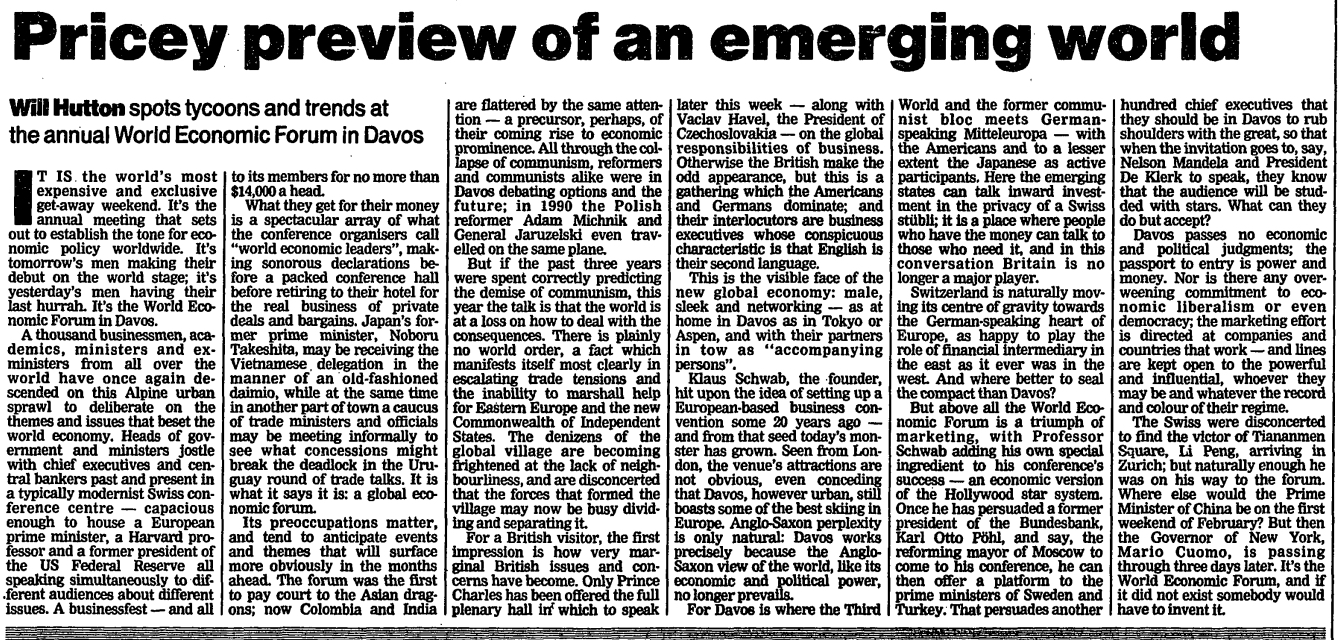
Hot air in a cold climate
The Observer, 3 January 1971
The cult of the management seminar is growing. So is the cost. Anyone with a finely developed sense of the ridiculous will welcome the news that in Davos, Switzerland, later this month 500 of Europe’s top businessmen will each pay about £700 to sit and learn at the feet of such mighty gurus as Herman Kahn and John Kenneth Galbraith.
The first European Management Symposium, organised by the Geneva business school, Centre d’Etudes Industrielles, to celebrate its 25th anniversary, will cost each visitor £500 in registration fees, £100 for accommodation, plus travel (£53 fare from London). You can, of course, add a few pounds here and there for drinks and other sundries which businessmen require when they are away from home. It is a tribute to this leading business school that the huge talk-in will be a raging financial success.
The list of speakers reads like the International Who’s Who: as well as Messrs Kahn and Galbraith, Jacques Maisonrouge, president of the IBM World Trade Corporation, Jean Rey, president of the European Economic Community, are among the notables who will be disseminating costly words of wisdom. For those who are not content simply to listen, management consultants Urwick Orr are organising a massive business game using four computers and six of their consultants.
• This is an edited extract. Read the full article.
The great and good in Davos
By Alex Brummer in Davos
3 February 1990
A spiritual breakfast with Mother Teresa, a contact lunch with Ted Heath, dinner with the Prince of Darkness, Richard Perle and a fiesta Mexicana paid for by one of the most indebted countries, were among the delights available here yesterday as some of the most important people in the world (some might say self-important) assembled for an annual bout of networking.
Or to express it in the global-speak of the World Economic Forum, which views itself as a government of rationality in exile, an annual opportunity for “high-level global personalised interaction”. High-level it certainly is.
At 4,400 feet above sea level, the Swiss resort of Davos lays claim to being one of the most exclusive winter-sports centres in Europe. That, of course, was in the days when there was snow.
Three years of the snow equivalent of drought have left Davos as a resort searching for a role. In the past, participants at the economic forum would arrive at brainstorming sessions pink-cheeked from an early-morning romp on the piste. Now they arrive scraping the mud off their boots.
The attractions at the half-built Congress Centre, with its computer message system and nuclear fallout centre, are enormous. For the high-minded there was a chance to listen to a full plenary session on the Economic Outlook for the 1990s, where a governor of the US Federal Reserve System, the dour Mr Wayne Angell, battled it out in public with Wall Street’s Doctor Doom, Henry Kaufman, who believes the days of the dollar as the world’s foremost reserve currency are over.
Alternatively, it was possible to attend a personalised briefing session on: “Domestic transformation and international travail: the history of modern Japan”. Just the thing for elevenses.
Many an “accompanying person”, the delicate name that the forum applies to spouses and others, can be seen ringing her or his hands because they have missed the Davos equivalent of a Rolling Stones concert, a talk-in by six Soviet vice-ministers.
For the intellectual benefits of the forum, participants (largely captains of industry) pay $7,500 plus travel, hotel and dining expenses. Theoretically the idea is to open minds to developments sweeping the world’s political system and economy. But the real prize is a chance to meet the alternative government itself.
This informal congress of some 70 government ministers from all over the world, including our own Mr Kenneth Clarke taking a break from ambulances, has attracted many of the great and good from the new central Europe.
Most of their business is conducted in secret assemblies. What more logical place, however, for Chancellor Helmut Kohl of West Germany and prime minister Hans Modrow of East Germany to network today on reunification but in a German-speaking Swiss canton?
So enthused was Mr Klaus Schwab, grandly styled professor, founder and president of the World Economic Congress, by these momentous events that he dropped his customary English opening remarks and spoke in his natural German instead. It was an eloquent recognition of new realities in Europe.
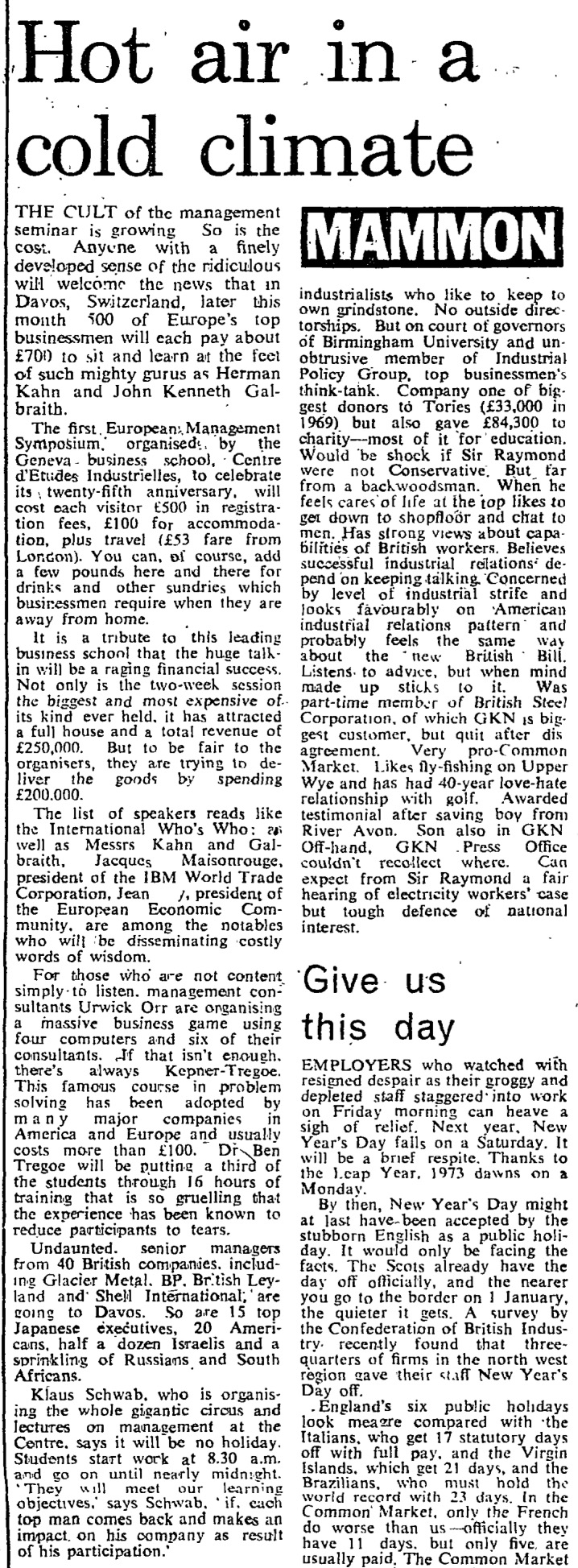
Pricey preview of an emerging world: tycoons and trends at the World Economic Forum
By Will Hutton
3 February 1992
It is the world’s most expensive and exclusive get-away weekend. It’s the annual meeting that sets out to establish the tone for economic policy worldwide. It’s tomorrow’s men making their debut on the world stage; it’s yesterday’s men having their last hurrah. It’s the World Economic Forum in Davos.
A thousand businessmen, academics, ministers and ex-ministers from all over the world have once again descended on this Alpine urban sprawl to deliberate on the themes and issues that beset the world economy. Heads of government and ministers jostle with chief executives and central bankers past and present in a typically modernist Swiss conference centre – capacious enough to house a European prime minister, a Harvard professor and a former president of the US Federal Reserve all speaking simultaneously to different audiences about different issues. A business-fest – and all to its members for no more than $14,000 a head.
Its preoccupations matter, and tend to anticipate events and themes that will surface more obviously in the months ahead. The forum was the first to pay court to the Asian dragons; now Colombia and India are flattered by the same attention – a precursor, perhaps, of their coming rise to economic prominence. All through the collapse of communism, reformers and communists alike were in Davos debating options and the future; in 1990 the Polish reformer Adam Michnik and General Jaruzelski even travelled on the same plane.
But if the past three years were spent correctly predicting the demise of communism, this year the talk is that the world is at a loss on how to deal with the consequences. There is plainly no world order, a fact which manifests itself most clearly in escalating trade tensions and the inability to marshall help for eastern Europe and the new Commonwealth of Independent States. The denizens of the global village are becoming frightened at the lack of neighbourliness, and are disconcerted that the forces that formed the village may now be busy dividing and separating it.
For a British visitor, the first impression is how very marginal British issues and concerns have become. Only Prince Charles has been offered the full plenary hall in which to speak later this week – along with Vaclav Havel, the President of Czechoslovakia – on the global responsibilities of business. Otherwise the British make the odd appearance, but this is a gathering which the Americans and Germans dominate; and their interlocutors are business executives whose conspicuous characteristic is that English is their second language.
This is the visible face of the new global economy: male, sleek and networking – as at home in Davos as in Tokyo or Aspen, and with their partners in tow as “accompanying persons”.
The Swiss were disconcerted to find the victor of Tiananmen Square, Li Peng, arriving in Zurich; but naturally enough he was on his way to the forum. Where else would the prime minister of China be on the first weekend of February? But then the Governor of New York, Mario Cuomo, is passing through three days later. It’s the World Economic Forum, and if it did not exist somebody would have to invent it.
• This is an edited extract. Read the full article.