
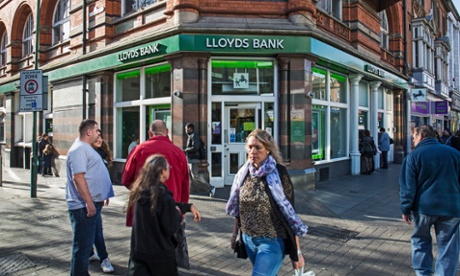
As pre-election bribes go, it’s not the ugliest you’ll find. All the same, the chancellor’s talk of discounts and sweeteners for retail investors who buy Lloyds Banking Group shares in a post-election sell-off should be treated with extreme suspicion. George Osborne’s plan carries the strong whiff of a bung to those people able to write a cheque for a few thousand quid at short notice.
The discount element is – up to a point – defensible. Large share placings usually happen slightly below the stock market price. UK Financial Investments, the body managing the state’s holding in Lloyds, has offloaded chunky holdings to pension funds and City institutions twice in the last two years. There was a 3% discount when £3.2bn-worth of stock was placed in September 2013. In the next tranche, in March 2014, the discount was 4.6%.
So a suggested 5% for retail buyers would be more generous, but not wildly so. That’s as long as 5% does not mysteriously become “at least” 5%, or even a 5% discount on the price paid by City institutions in a parallel offer.
The “loyalty bonus” element, however, seems straightforwardly wrong. It looks like an indefensible gift to a favoured few. The idea is that anyone who holds their new Lloyds shares for a year would get one for every 10 they own. Why?
To promote “long-term share ownership,” says Osborne. But 12 months should be nobody’s definition of long-term investment. If £4bn-worth of shares qualifies for the sweetener, the government could end up handing out £400m of shares for free. Why should other citizens bear that cost?
The Conservatives should forget about trying to revive vague feelgood notions from privatisations of the 1980s. Circumstances are different. British Telecom, British Gas et al were coming to the stock market for the first time. At Lloyds, the nation as a whole bailed out the bank in 2009, and the correct way to shed the remaining 22% stake is to maximise proceeds for the benefit of all.
That means aiming to get as close as possible to the market price, set every Monday to Friday in active trading. The principle should apply whether selling to private punters or to pension funds. Anything else would be a distortion – or officially sanctioned robbery from the public purse.
Global shift?
Here we go again, another round of speculation about HSBC leaving the UK and returning to Hong Kong. This idea had a half-hearted revival when George Osborne increased the UK bank levy – which is calculated on a UK-domiciled bank’s global assets, not just those in this country – in the budget in March.
On Monday, HSBC chairman Douglas Flint declined the opportunity to quash the chatter. “We are beginning to see the final shape of regulation, the final shape of structural reform, and as soon as that mist lifts sufficiently, we will once again start to look at where the best place for HSBC is,” he told investors in Hong Kong.
To be fair, Flint was completely non-committal; maybe he just wanted to be polite in front of a local audience. But the misty outlook for UK regulation and the bank levy has nothing on the Beijing-style thick smog that HSBC would be embracing if it moved its base to Hong Kong.
It’s simple. In the UK, banks are regulated by a body accountable to a democratically-elected parliament. Hong Kong, by contrast, comes under the increasingly watchful gaze of the Chinese Communist party; nobody can know what the political landscape will be 20 years from now.
What’s more, if they got on the wrong side of Chinese officialdom on, say, customers’ tax avoidance and evasion, Flint’s successors at HSBC could expect stiffer sanctions than a two-hour verbal lashing by Margaret Hodge’s public accounts committee.
Fairer fees
Impressive stuff from Neil Woodford: his new investment trust, Woodford Patient Capital, which will hunt for investments in early-stage UK businesses, has raised £800m from a standing start. This launch combined a popular (deservedly so) fund manager and an unfashionable field of investment: Woodford’s reputation won, which is good news for interesting UK tiddlers seeking funding.
There was another novelty here: a fee structure that looks genuinely demanding. The manager will only receive performance fees when investment returns exceed a 10%-a-year hurdle. That will not be easy to clear on a rolling basis. It’s good to see a mainstream manager putting fairer fees near the centre of his pitch.
