
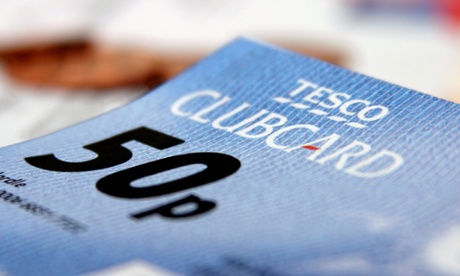
WPP has lodged a bid for the customer data company that created the Tesco clubcard.
A source with knowledge of the talks confirmed that the world’s largest advertising group had made an approach for Tesco-owned Dunnhumby, which gathers and analyses data from almost 1 billion shoppers around the world. The information is then used to help companies create customer loyalty programmes and create tailored offerings for shoppers. Spokespeople at WPP and Tesco declined to comment.
The deal would also give WPP access to data that helps conglomerates such as Kellogg’s and Coca-Cola set prices and promotions.
Tesco announced in January that it was considering a sale of the business, as part of a broader strategy to win back customers who are opting for low-cost discounters rather than clubcard vouchers.
Dunnhumby was founded by husband-and-wife team Edwina Dunn and Clive Humby at their kitchen table in 1989. The business is now rumoured to be worth £2bn and counts Danone, Nestlé and drug manufacturer GlaxoSmithKline among its clients. But the firm is most closely associated with the Tesco clubcard, launched in the UK in 1995.
At the time this was a groundbreaking loyalty scheme that helped propel Tesco to the position of the UK’s biggest supermarket. The scheme allowed Tesco to profile its shoppers, finding out whether they were a family with kids or a singleton subsisting on beer and ready meals. Tesco took a majority stake in 2001, later increasing its control, while Dunn and Humby bowed out as shareholders in 2010.
As the supermarket battles to maintain market share, Tesco announced in January that it had hired Goldman Sachs to weigh up whether to sell the data-mining business.
The decision was widely expected as Tesco’s new chief executive, Dave Lewis, who joined last September, seeks to revive the fortunes of the supermarket by closing stores, sacking thousands of staff, relocating the head office and hiving off non-essential parts of the Tesco empire. The troubled supermarket has already sold Tesco Broadband and the movie streaming service Blinkbox.
According to its latest results statement, WPP made 65 acquisitions last year, of which 53 involved data firms. It said that its next round of acquisitions “will be focused on our strategy of new markets, new media and data investment management, including the application of new technology and big data”. The company recently reported a 12% rise in pre-tax profits to £1.45bn for 2014.
The company has earmarked up to £400m this year for acquisitions. Last month WPP paid $300m (£202m) for a stake in ComScore, a US-based company that measures internet audiences. As part of the deal, WPP’s market research unit, Kantar, will team up with ComScore to help advertisers measure the performance of their campaigns online and offline. WPP hopes that the ComScore investment and the Kantar partnership will create a rival to Nielsen in media measurement across all platforms.
WPP’s strategy will be outlined to large investors in June at its annual shareholder meeting. WPP’s chief executive, Sir Martin Sorrell, is also likely to come under scrutiny after it emerged on Monday that he earned more than £36m last year.
WPP revealed it had awarded Sorrell more than 2.3m WPP shares worth £36.04m under its Leap incentive plan. The Leap payment is likely to take Sorrell’s total pay for last year to more than £40m, including salary and short-term bonus.
