
The thinktank Centre for Cities’ new report, Cities Outlook 2015, has found that cities and towns in the south of the UK are far outperforming those in the north (as measured between 2004 and 2013) – and that the inequality gap is widening.
The findings sparked a heated debate among readers from across the UK, and beyond. Many agreed that London receives too much investment compared to the rest of Britain, while others pointed out that not everyone in the capital benefits from this disparity. Amid widespread calls for greater levels of regional governance, a common question in the minds of those suffering the effects of inequality was: who’s to blame anyway?
Here’s a selection of the thoughts, ideas and stories you shared with us:
Life in the north

I am from Sunderland, we have been overlooked for decades. Its a shame as the people are great and would love to work and don't see why they should move South to find work, especially as they cannot afford to live there.
I don’t think the politicians in London have any idea how poor the transport system is in this area of the country ... The service I experience here is from a different century, and makes living and working in the area virtually impossible unless you have access to a car.
I come from the north but have lived in the south-east since leaving university – simply because of where the work is. The north/south divide is real, but not easy to fix ... The brutal truth is that the original reason to locate many northern towns has gone, and no new reason has been found.
- stevegb
Is it really a north-south divide?
Agreeing with the report’s findings, many readers pointed out that the “divide” of UK prosperity is not between north and south, but between the south-east and the rest of the UK:
The south-west is VERY different to the south-east with its own issues, seemingly higher cost of living than the north but much lower wages than the south-east presenting some massive affordability issues.

Southern cities or do you mean London and the southeast? I will be glad to report if down in Cornwall we see any glimmer of all this wealth sloshing round..... But I doubt it will ever happen.
Regional governance required
A number of readers felt that establishing regional political parties or powers as part of a federal government could help rebalance economic growth:
Just further makes the case for a federal UK. All power is concentrated in London and the biggest area naturally takes precedence. But what really cripples the north is lack of representation.
- diddoit
This is all the result of centralisation of spending and planning in the metropolis and “market forces” being allowed to control everything ... There needs to be a return to regional government with real power and spending. All the “caps” on regional spending prevent regional growth, thus increasing the jobs and cost of living in the metropolis
The only answer must be true regionalism. We have a golden opportunity with dev max in Scotland to do the same for Wales and the English regions; a sort of big bang. Assemblies should represent 4-8 million in population. These 10 or so regions should control: health, welfare, policing, local infrastructure and above all economic development.
- PLATO28
Time for centralisation to be reversed, and tax-raising powers enhanced in the regions. Add to that Council Tax reform, and maybe the chronic national imbalance can be addressed.
- classman

There's a very easy way (given political will behind it) to solve that problem. It's called a "UK-Wide Constitutional Convention" - as committed to by Ed Miliband (immediately after the Scottish Independence Referendum), and advocated by the Greens and LibDems - a citizen driven forum (with involvement and endorsement of political parties) through which all elements of civic society can make representations about what constitutes their individual locality?
City Regions, in some circumstances, might be one way forward but the point here is that citizen focused input is the driving force , not diktat from on high by political élites. I don't support City Regions (outside London) because they don't really work - half (at least) of the population of Cheshire, either works or is directly linked to the Greater Manchester and Merseyside conurbations so why split them off from the cities they are inexorably interwoven with?
Our local democratic renewal campaign group took various models, for effective devolved governance on to the street in Manchester - see graphical data prepared for "Scotland Decides" public meeting at this URL - the results were surprising and not what you might expect.
Others thought that relocating central government would be a step in the right direction:
Once again, we’re reminded that the way to tackle the UK’s problems is to move the government. In one stroke, London’s housing and transport problems would be solved – and the country’s economy rebalanced.

Again, concentrating all the economic and political power in one city is a disastrous policy. The Dutch have done things better, Amsterdam-Den Haag, economic power in one, political power in the other. Not the UK method of London-London-London-London and the surroundings counties feeding it to the detriment of everywhere else.
There is inequality in London too
Simply saying that people in London are more successful than those in the rest of the UK is reductive. Some of our readers observed that the situation in the capital is still one of stark inequality; others saw life in the north as a better deal:

Not just the South East versus the rest but the prosperous bits of SE England versus the rest. London, shamefully for such a wealthy city, has some of the poorest parts of the UK literally in the shadow of The City.

I live and work in London. No way I get paid enough to buy a house in London,however people up north of they have a job can afford a really nice property. This North south divide. I think the people up north if they can get/have a job are much better off.
The first step is investment
While a restructuring of governance was desired by many, increased investment (especially in transport infrastructure) outside of London was highlighted as critical to redistributing economic benefits:
There is not a single transport infrastructure project outside of London that gets anywhere near the billions being spent in the capital. Necessary billions I might add; however, the rest of the UK needs much more investment too ... it’s not an either/or, it should be both.
It is not logical that the government invests the taxpayer’s money in high-cost areas such as the south. It must start investing in low-cost areas, so that the taxpayer gets value from the tax paid.
Spreading the wealth outside the major cities, by improving transport within the regions and investing money to develop depressed towns would help. This issue isn’t just a north/south divide, the divide is between the major cities and the surrounding towns.
- MRWINNER
London is surrounded by three international airports and there is an ongoing argument that says that’s not enough!! Why not improve or build another airport more central to Birmingham say? Nobody can argue that the road network is inadequate, and a move would in turn generate work
It is the south-west that has been even more cruelly ignored by parties of all persuasions. Seen as God’s waiting room by many, there is actually some real vibrancy here that could do with some investment ... At least the north of England gets lip service. Here in Exeter, we are not so much the northern powerhouse, as the bricked up outhouse, forgotten in the march of progress, but paying higher utility and rents than most, and getting sod all in return.
Alongside pull factors there has to be powerful ‘push’ factors, attempts by government to encourage industry and employment to resettle in the north, in order to provide the basis for that self-sustaining growth that flows from concentration of activity. Without the push, the pull will fail.
- jakedog

London receives an unjustified level of government subsidy - from infrastructure schemes such as Crossrail through to tax credits because global companies can't be bothered paying their cleaners etc a proper wage. If towns outside the London economy had this investment, the North/south divide would be different.
What about HS2?
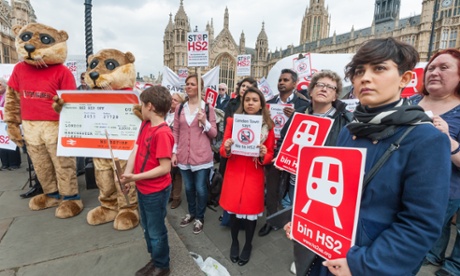
Advertised as an “engine for growth” which will “rebalance” Britain by more efficiently connecting the north of the UK to the south, the high-speed rail link HS2 is a huge focus of government investment in infrastructure which divides opinion:
If anyone thinks one new railway is going to “transform” the north’s economy, think again. We need a much more basic restructuring first; oh, and the introduction of some half-decent wages would be welcome.
Wait until the HS2 rail link is built. All that will do is suck even more business from north to south
- Yorkster
I support HS2 but it should be linked to HS1 to provide a direct route to mainland Europe, enabling provincial cities and peripheral regions to forge new economic ties with our main markets
- padav

The problem with HS2 is that it presupposes that growth depends on being linked to London. It turns the midlands into a London suburb when what the rest of the country really needs is the ability to grow without reference to London.
Better transport links across the North would help that region grow a lot more than giving Londoners more places to commute from.
Cutting the North off from the South is a radical solution, but I don't see it catching on. No one is seriously arguing that the M1, East coast line and west coastline should be dug up in order to help the North.
But if we don't build HS2, that's effectively what we would be doing when the west coast main line can no longer cope. It is too full, and a Bypass is needed. There's no reason not to build the bypass to modern standards, is there?
I don't remember the M40 being criticised as being likely to turn Birmingham into a suburb of London, or to send jobs south. And yet, the reason for building the M40 was for precisely the same reason as the need for HS2 - the existing route is chock full of traffic.
Who’s to blame?
As the general election looms, many readers wanted to explain how this inequality originated – and which party we should blame for it:
Thatcher’s destruction of the northern industrial base in favour of a “service” economy (look how well that’s working!) was partly reinforced by Blair and Brown. Coupled with the defenestration of Local Authorities because they weren’t “one of us”, the handing over of most local functions – transport, education, care, etc – and the centralisation was complete. Except it’s been a disaster
The North/South divide has been gaining speed since the 2 world wars however it has really accelerated since the Thatcherite Big Bang hence the focus on changes brought in by the Conservatives that were, it's true, continued by Labour….though it;s also true that Labour did invest in northern cities and communities to try and bridge the gap.
Those people trying to make anti-Conservative points about this should remember that these figures are about the change between 2004 and 2014, which was under a Labour government for 6 out of 10 years.
Things have been like this for a long time, and neither main party has a good record on this topic. We need workable solutions to the issue, not party political argy bargy.
Come come now - Crossrail, Greenwich, major transport and infrastructure abounds in Londn to an extent that we in the north can only dream of. Basically, the LEP's have been a disaster and far from narrowing the economic gap they have widened it. As have the Tory deficit reduction policies that undermine northern urban aras.
What do you think? Share your thoughts in the comments below.

Here in the North East, the only real jobs are in the public sector. I'm from London but now live in a former colliery village. The level of poverty is shocking and nothing is done. 'Job creation' is a dirty word for local councils up here.