
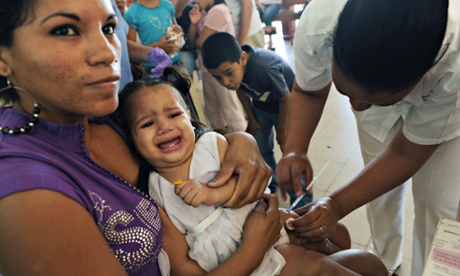
A campaign to immunise hundreds of millions of children in developing countries from fatal diseases has been hit by the strength of the US dollar and the surge in value of the Swiss franc.
The Global Alliance for Vaccines and Immunisation is seeking to raise funds to buy 2.7bn doses of vaccine, to protect against illnesses and diseases such as diphtheria, tetanus, pneumonia, diarrhoea and polio.
Exchange rate moves are making it harder for the group to hit this goal, ahead of a major fundraising conference in Berlin later this month. Gavi had been aiming to raise $7.5bn (£5bn) to fund a new round of immunisation, but exchange rate moves mean this target, even if it is met, may not be sufficient to buy the drugs.
Seth Berkley, CEO of Gavi, said donors were discussing this challenge, which could hurt its bid to prevent 1.5 million children under five dying each year of preventable diseases. “The change in exchange rates has affected us pretty dramatically. We made our original requests almost seven months ago and exchange rates have dramatically changed,” Berkley said at a press conference at the World Economic Forum in Davos, Switzerland.
Several wealthy countries have not, as yet, committed any funding to Gavi’s new “pledging conference”.
Canada, Germany and the UK have all made funding commitments for the next five years. America has not, Berkley explained, because such pledges need congressional approval, while other countries are saving their announcements for the 27 January event.
Half a billion children have been immunised through Gavi since it was launched at Davos 15 years ago. The group estimates it has saved 7 million lives. It uses bulk-buying power to fund immunisation programmes for developing nations that cannot afford standard prices charged by pharmaceutical firms.
The dollar has strengthened against most major currencies since last summer, on expectations that the Federal Reserve will start to raise interest rates this year. That means pledges made in euros, for example, are now less valuable.
“We purchase our vaccines in dollars, a couple in euros, but most in dollars. If we don’t end up with that adequate finance then we don’t be able to pay for those vaccines,” Berkley explained.
“The critical thing is to be able to purchase those vaccines. It’s not so much that we need X amounts of money, we’re actually purchasing 2.7bn doses of vaccine in this next period. That’s what drives the cost.”
Gavi buys many of its vaccines from pharmaceutical firms based in Switzerland. Berkley said the spike in the value of the swiss franc this month, after its central bank stopped pegging it to the euro, also has serious implications for Gavi’s funding plans.
“If we are short we will ask others to step up. The other side is that we will go back to the companies and have discussions with the companies, if it turns out to be an issue,” Berkley said.
Dr Maria Furtwängler-Burda, the One campaign ambassador for child health, has worked in the developing world and believes Gavi plays a vital role. “To me it’s an incredibly powerful idea that through simple vaccination against the common bacteria that cause diarrhoea and pneumonia, we can save the lives of children who cannot make it to any doctor’s shelter. This is a wonderful thing to do.”
Canada has pledged $500m to Gavi’s new funding round. Its international development minister, Christian Paradis, urged other countries to make commitments by 27 January. “We know immunisation works. We believe in this. It is one of the best investments you can make to save lives,” Paradis said.
