
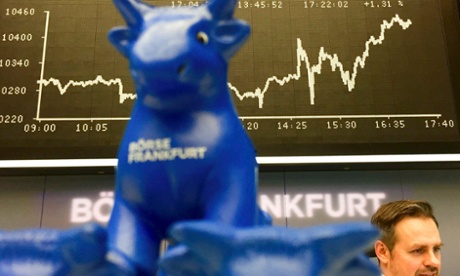
The reaction of the euro spoke volumes. Within seconds of Mario Draghi announcing that the European Central Bank would buy €60bn of government and corporate bonds a month from March until at least September 2016, the single currency dropped sharply on the foreign exchanges.
Conclusion? This was a bigger package than the markets had expected until only a couple of days ago when leaks started to come out of Frankfurt suggesting that the ECB’s version of quantitative easing would be bigger than anybody had previously expected.
Nariman Behravesh, IHS’s chief economist, said Draghi’s plan did not match up to the Federal Reserve’s “big bazooka” approach but neither was it a pop gun. “It is a small bazooka,” Behravesh said.
This looks like a fair assessment. The ECB has taken steps to return the size of its balance sheet back to where it was in 2012. In the meantime, repayments by eurozone member states of the loans they took out in the depths of the financial crisis had acted like a tightening of monetary policy.
What’s more, had the ECB not done something that looked significant, there would have been two malign consequences. The euro would have risen on the foreign exchanges, making exports dearer and imports cheaper. That would have reduced both growth and inflation. Even worse, the ECB would have given the impression that it was relaxed about the fact that the eurozone is already in deflation, making it more probable that the deflation would have become embedded.
The final piece of good news is that the bond-buying programme will continue until inflation returns close to the ECB’s target of close to, but below, 2%. The potentially open-ended nature of the programme could prove important if inflationary pressure remains weak, as it almost certainly will.
There are though, inevitably, some big caveats. The eurozone is supposed to be moving towards banking union, yet only 20% of the asset purchase programme will be subject to risk-sharing. Individual central banks will be responsible for the other 80%. What sort of banking union is that?
Clearly, the risk-sharing was a concession made to Germany, as was the decision to ensure that Greece could not be part of the scheme. The crisis and its aftermath have exposed the limitations of what is supposed to be an independent central bank. The delays, the horse-trading and the limitations of the ECB plan show how deeply politicised it has become. The ECB president is holding the ring between two rival camps: the inflation hawks of northern Europe led by Germany and the French-led group calling for more monetary activism.
Draghi was keen to point out that Thursday’s announcement provides no panacea for the eurozone and he is right about that. Even in the US, where QE was bolder and more rapid, the impact of QE has been relatively modest and has done more to boost the price of assets than it has for the real economy.
In the eurozone, where the banks are still highly risk-averse and are calling in loans to small firms rather than extending new ones, the main impact of bond purchases will be through a weaker currency. Parity against the dollar looks a real possibility and that will help exports, but there is unlikely to be the investment-led boom Draghi is looking for.
For Americans and Brits, though, this is a good time to be planning that trip to Berlin, Paris or Rome.
