
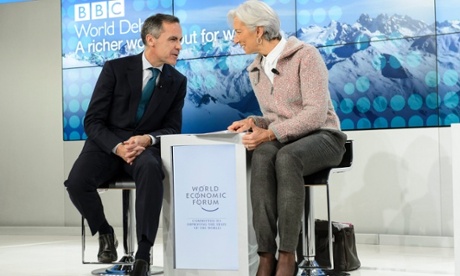
The governor of the Bank of England, Mark Carney, challenged the world’s big technology companies to pay more tax as he stressed the perils of growing inequality at the World Economic Forum, in Davos.
Carney said IT companies needed to show a greater sense of responsibility. “Some of the firms that take advantage of international tax rules are the tech companies,” he said. “The amount of tax they pay is small in relation to the system. A sense of responsibility is needed.”
Carney did not name any tech companies by name, but his remarks will add to the pressure on firms such as Google, which uses offshore arrangements to reduce its tax bill in the UK.
Latest accounts for Google UK show sales of just £642m in 2013 and corporation tax of £21.6m. The wider group, however, makes clear the scale of its business with UK customers was far larger — sales of £3.6bn ($5.6bn) in fact — the lion’s share of which was diverted through Ireland. This helped Google reach an effective tax rate of 15.7% for 2013 — well below the headline tax rate in the UK and all its major markets.
Carney’s comments fuel a controversy already raging in the UK, and last month George Osborne announced plans to impose a 25% levy on profits generated in Britain but shifted abroad.
The governor said he was optimistic about the benefits of technological advances but added that there would be a period of adjustment while societies adjusted to the disruption caused. Technology’s ability to displace white collar jobs was part of the reason for the squeeze on wages, he added. “Many people are over-skilled for the jobs they are are doing, which keeps wages low.”
Carney said the importance of social capital had been underplayed during the period leading up to the financial crisis, when it was thought that markets provided the solution to every problem. Financial innovation, not all of it good, had allowed consumption to grow even while incomes were not rising. “One of my colleagues at the Bank dubs this the “let them eat credit” approach, Carney said.
Christine Lagarde, the managing director of the International Monetary Fund, said that over the past two years her organisation, once seen as a bastion of economic conservatism, had embraced the need to tackle inequality.
She said: “Inequality is not conducive to sustainable growth. If you increase the income share of the poorest you get multiplier effect that you don’t get if you increase the income share of the richest. Redistribution policies are not counter-productive for growth.”
In reply, Sir Martin Sorrell, chief executive and founder of the advertising company WPP, said the world needed wealth creators. “I founded a company with two people, which now employes 179,000 people in 111 countries and invests $12bn in human capital each year. I make no apology for that whatsoever.”
Hitting back at Lagarde, Sorrell – who has had run-ins with the City over his pay deals - said there was no evidence that equality led to faster growth.
