
In early March, I ordered a women's blouse from johnlewis.com for £79 from its Alice Temperley Somerset collection. When it arrived, the "swing ticket" said £69. I queried this and John Lewis said the higher website price was correct. I accepted this.
On my next visit to a John Lewis store, at Westfield, Stratford (18 April) the same blouse had a £69 price tag.
JL said that originally, in August and September 2013, the blouse was £69. Since then it has been £79. JL said that when I made my purchase in March the correct price was £79.
As with the blouse I was sent, the swing tags in store were incorrect. If I had decided to purchase in store, the till would have shown the correct (higher) price and I would have been invited to pay that price.
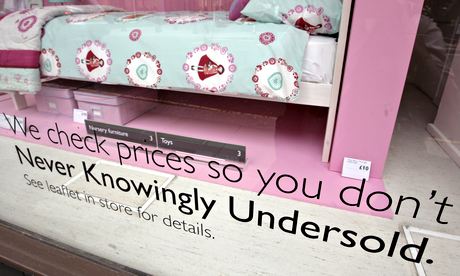
This is not my understanding of contract law, which is that JL would have been obliged to sell me the item at the advertised (lower) price. My view is that having now seen the blouse on two occasions at £69 (with no apparent discount), JL's "never knowingly undersold" brand promise should apply.
JL's argument is that the prices I have seen, subsequent to my contracting to purchase at £79, are incorrect and the brand promise does not apply. They have also said that claims under the brand promise must be made within 28 days of purchase.
I acknowledge that I accepted the position at the time of the first query but yesterday's experience has underlined my sense that JL has got it wrong. Today on johnlewis.com the blouse is discounted to £55. JT, London
Possibly the most famous promise in British retailing, "never knowingly undersold", has been at the heart of John Lewis's business since 1925. It means that if you spot something cheaper elsewhere – before or after making the purchase, or in John Lewis itself – it will match the price. It will match a local shop within an eight-mile radius and lower the ticket price for all customers; if you spot a better price outside this, it will lower the price as a one-off.
John Lewis explained that it analyses the selling price of any item based on what is pays the supplier and the cost of similar items within its own and competitor ranges. With this blouse, it says that it had incorrectly priced it at £69 rather than £79.
A small level of stock with the lower price had reached some shops and its online distribution centre before the change to the ticket was made.
However, £79 was recorded on its central pricing system, so online customers would have been charged £79. You are correct in your understanding of consumer law.
JL admits it should have refunded you £10 when you first pointed out this problem. The blouse has since been reduced to £55 and it has refunded you the £24.
We welcome letters but cannot answer individually. Email us at consumer.champions@theguardian.com or write to Consumer Champions, Money, the Guardian, 90 York Way, London N1 9GU. Please include a daytime phone number
